The Probation Service: managing the delicate balance between rehabilitation and risk

The Probation Service's work is driven and informed by the knowledge that people can and do change. Pic: iStock
Preparing probation reports to assist in sentencing decisions is a central element of their work and involves face-to-face interaction with the offender.
“For example, if somebody was on remand for serious charges like murder, you are tasked to talk to them in prison as part of getting an overview in terms of their character. Depending on other types of offences and their severity, we can meet people in the prison, in our office, in the community or in their homes,” John outlines.
Staff are very conscious of their own personal safety when it comes to meeting clients.
“We have our own health and safety policies regarding risk assessments. When we review a file, we might call a Garda or touch base with a court or a solicitor.
“If we were really worried about somebody who has a history of threats or violence to staff - whether it’s us or Tusla staff or maybe it’s in the prison - we would take all that into account. We might say that maybe we can’t see this person in a home visit or we can’t see this person on our own, so we have to double up. We do take certain steps.”
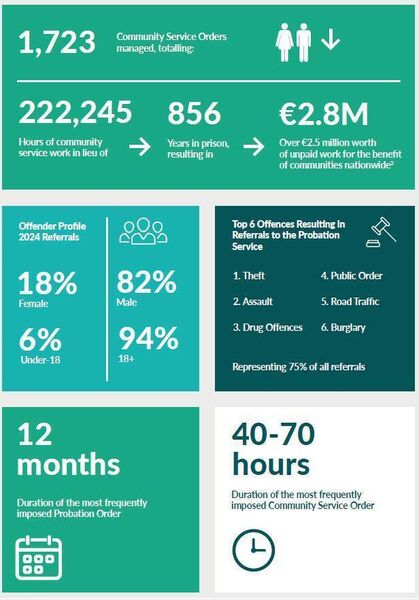
A probation report can help identify what’s going on in a person’s life that could affect their chances of reoffending. When preparing the report, the probation officer will consider the seriousness of the offence; a person’s attitude to the offence and to the victim, and the supports available to the person. A plan will be agreed to help the person try and avoid reoffending.
A probation report can be a very detailed body of work involving a range of information on a person, including possible previous convictions.
“A lot depends on the person who has committed the offence and depends on the severity of the crime or the offence. And if they’re known to us here before, then we’ll have previous information. The probation report might relate to a young adult where we may need to talk to a partner or a parent. That may also involve bringing a letter to us from an employer,” he explains.
Needless to say, such reports can play critical roles when it comes to a judge ruling on a particular case.
“The judge can very much be dependent on the probation report in front of him to make a call on the person. We are very aware of this. When a court case is reported on, it might have a quote from one of our reports that the judge has read out loud.
“It’s a reminder to us that there’s weight behind our reports.
“A report can influence sentencing; whether a sentence or a portion of it is going to be suspended or not, and whether it might include a period of probation supervision, which means that that person is back in the community.
“In reports that we prepare, we can also recommend that the person is not suitable for probation supervision because the person has no interest in working with us.”
Throughout our conversation, John highlights the importance of keeping the victim to the forefront at all times.
“Every piece of work that we do, we always have to try and keep the victim in the room or in our conversation in the report. We have to consider the harm that the offender has done that has affected someone so badly.”
Supervising people in the community who are subject to different types of court orders, from district court level upwards, is also very demanding work for staff.
Probation type supervision includes probation orders, fully suspended sentence supervision orders, and supervision during deferment of penalty. The latter is where the court postpones the penalty to a further date on condition that the offender responds to the supervision of a probation officer and avoids reoffending.
There are also various supervision orders when a person is released from prison.
They can include part suspended sentences, temporary release supervision, life sentence prisoners on supervision and sex offenders on supervision in the community.
“The court can make an order for supervision with or without a probation report. Or there might be a request for a community service report, which we can do quickly because there’s no risk assessment involved.
“When it comes to somebody who is released after serving a prison sentence for murder, they’re on probation supervision for the rest of their life.”
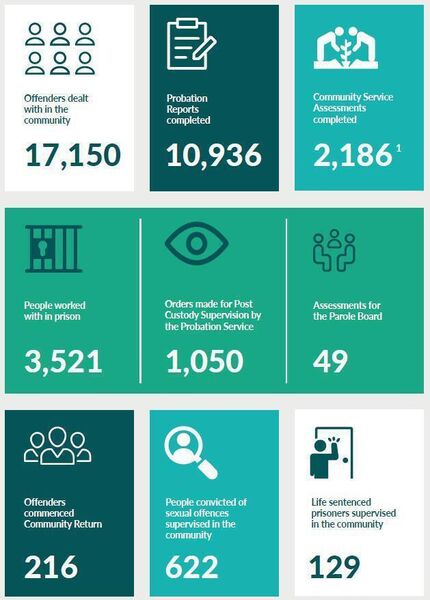
For John and his staff, one of the keys to the success of working with an offender is relationship building in partnership with other agencies. “It’s about meeting with the person and making what we call a case management plan and a supervision agreement. The level of intervention and the level that we engage is based on somebody’s level of risk. A high-risk client would be seen every single week.
“How we manage supervision orders will be different for everybody. Some might have caring responsibilities, maybe for elderly parents or children, so we have to factor that in.
“A person could be homeless or the person could have an addiction. So I couldn’t reasonably expect those people to do a course about completing a CV and getting a job. So everybody’s case management plan is different.
“We have a model in probation called the RNR model - risk, need, responsivity. The level of risk and the level of need determines the response that we provide,” John explains.
When it comes to the whole area of rehabilitation, there is a strong sense of realism among staff about the different levels of progress that can be achieved.
“So the case management plan is goal oriented. We pick a number of goals, setting a timeline and building in the reviews. The nature of the plan depends on the person, depends on their progress and depends on the length of the supervision.
“We don’t expect people to come out of probation to be brand new, completely different people. And sometimes it can be a very, very small win. That is enough for that person, but also for us - like turning up to appointments, being able to get up in the morning and maybe progressing from a 3 p.m. appointment to a 9.30 a.m. appointment.
“That means that they really want to try. We could be talking about someone who has had no structure, no routine, left school early and maybe have a medical care history.
“We can’t do anything with them however if they don’t show up.
“It can be that basic all the way up to somebody applying for and getting a new job. Or somebody applying for a position in a third level institution.
“In terms of intervention, we love to see change although it might not be seen as always possible with someone who is so ingrained in a particular lifestyle.
“But we do believe at some point that maybe there comes a time that they feel ready to make a change.
“Maybe it’s a stage in their life where they’ve just decided, I’m so done with prison.And so it’s about getting them at the right time, which is great.”
However, John is quick to admit that there are “deniers” and achieving any level of progress can often be very difficult.
“You may have a person who has served several years in prison and still would deny everything. So it’s very hard to kind of move that needle.
“As part of the assessment process or even in supervision, you might just have to tell them, sitting across the table, that you find what they might be saying to you very hard to believe.
“You know, you might just have to name it and challenge them to get a response.
“There has to be a challenge, especially for the people who have committed serious offences, who deny that it really caused any harm, deny the offence or say that it was all blown out of proportion.”
The Probation Service staff is always mindful of the need to balance rehabilitation work with managing risk in the community.
“Some of these people pose a risk to themselves or others. We’re actively trying to manage that risk that they pose to themselves and others and that’s a big responsibility.
“At least when they’re in the prison, you know where they are. You know where they’re sleeping that night.
“The level of risk, high, medium or low, will determine the level of our intervention.
“High level risk involves a lot of work with the gardaí.
“And sometimes we just have to do a basic check with the prison service to see if they have been picked up for new charges, or more generally, get a full picture of how they’re getting on.”
The Probation Service is a national organisation with more than 35 community based-offices nationwide and a presence in every county.
For counties Roscommon and Longford, John Maguire leads a team of five probation officers and one probation assistant.
There is no dedicated office for the Roscommon/Longford service, which shares office facilities in Athlone with its Westmeath counterpart.
Not surprisingly, case workloads for staff can be unrelenting and are carried out against the background of rising court referrals, the increasing complexity of client needs and prison overcrowding.

John points out that there are currently about 17,000 people nationally on probation and 6,000 people in prison.
From budgetary figures he cites, it’s clear where the bulk of the investment is going.
“In the last budget, the Probation Service got an extra €6.7m while the prison service got an additional €39m and there’s a lot more people in the probation service as clients than there are in prison.
“The prison service is massively under pressure and any rehabilitation work is not happening in the prisons at the moment because they are so overcrowded.
“The drive at the minute and the focus of the work in prison is around preparing people for release.
“I know the psychology services and the probation service in the prisons would love to do more direct work in the prisons but I don’t think they’re getting the opportunity to do that.
“It would be the ideal scenario where they are doing pieces with prisoners around victim-focused work, empathy around the harm that they’ve done, or offence-related work - work that is aimed at trying to develop an insight as to why they did what they did and how to prevent it ever happening again.
“That piece of work should start in the prison but unfortunately it only starts when they get out.”
Against the backdrop of a housing crisis, a major barrier to rehabilitation can be homelessness, according to John.
“We have people coming out of prison straight into homelessness. They are sent to the local county council and present as homeless. But some could end up having nowhere to go and that’s a massive concern and worry for us.
“Unfortunately, all we can do in those cases is advocate as best we can with the councils and with other housing services and supports.
“We can also talk to people who find themselves homeless about other options such as old friends and family members, but often times they’ve burnt their bridges.
“We will always work with them to try and identify some type of support or some option other than them going back to crime.”
While John said all stakeholders, including local authorities, are doing their very best in what is a very challenging landscape, he would like to see more resources invested in a range of areas, not least in the area of community mental health supports.
“You have people in the system and people who you deal with who have genuine mental health issues but are not really getting the help that they need when they’re in the community.
“Our own service could do a lot more as well if we had more staff and resources.
“We are also hindered by the fact that we don’t have our office in Roscommon, which would give us more of a central hub to work from.
“That is certainly what we would all like because if you’re trying to work with someone in North Roscommon, for example, they wouldn’t necessarily come all the way to Athlone.
“In this situation, we have to arrange to meet them somewhere.
“But I am very lucky to have an experienced and committed team here in Roscommon and Longford. They have built up a very good network and a good relationship with the courts service, the prison service, the guards, the councils and many other stakeholders.
“We are also very lucky that we have two local judges, Kenneth Connolly, and James Faughnan, who really understand the value of the Probation Service and what we do,” he said.
It’s very clear from speaking to John that despite all the challenges and obstacles that arise every day for him and his team, their commitment to making a positive impact on people’s lives and the wider community remains steadfast.
“As I said earlier, one of our core principles is that people have a fundamental capacity to change. You’re looking for ways to do that whether it’s through interpersonal skills or interacting with services.
“We could have staff who might be on leave but are still taking calls from people who they are worried about. I suppose what we do is a vocation for many of us working in the Probation Service.”
- Published under the Courts Reporting Scheme