Lions in Connacht, lambs in the All-Ireland Series
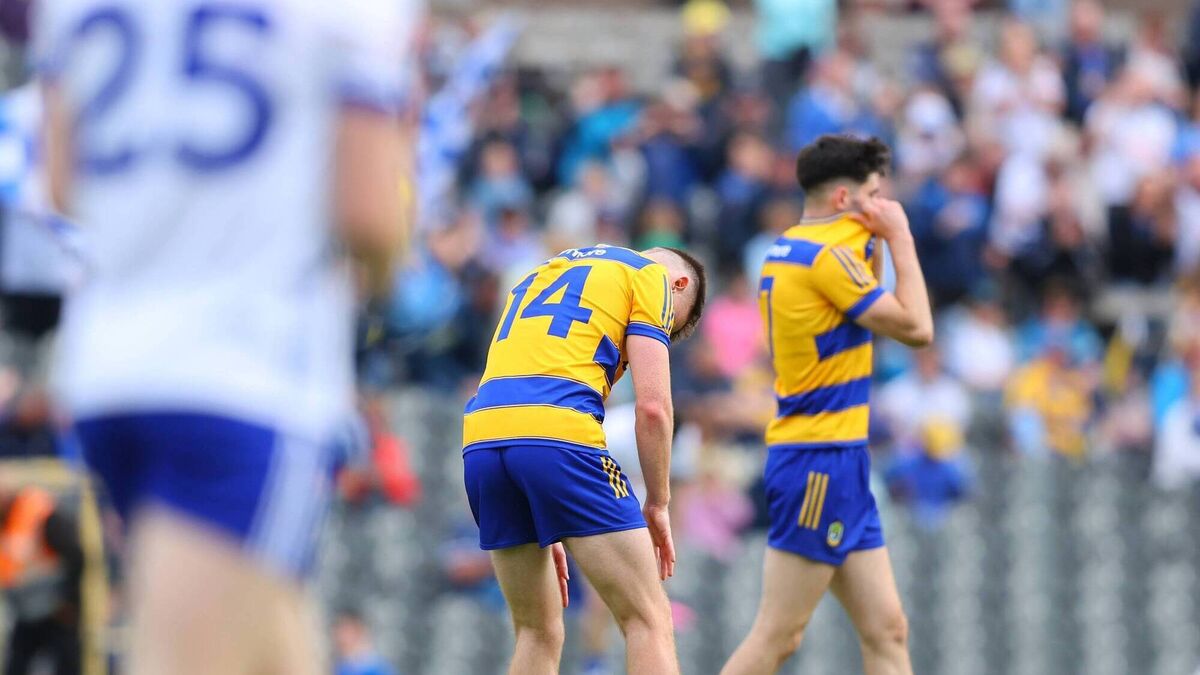
TOUGH DAY AT THE OFFICE: Darragh Heneghan and Senan Lambe show their disappointment as Roscommon are dumped out of the All-Ireland Senior Football Championship by Monaghan at St. Tiernach's Park, Clones, on Saturday last. Picture: INPHO/Tom O’Hanlon
Roscommon supporters may have made up the lion’s share of the crowd of just over 10,000 supporters in St. Tiernach’s Park last Saturday, but that wasn’t the reason why the Rossies drew a much louder roar of approval from the crowd than the home team when the two sides ran out onto the playing field in Clones.
The extra few decibels from the travelling cohorts were in recognition of the unmistakable figure of Enda Smith, wearing the number 26 jersey but clearly available to play some role in the game despite strong rumours to the contrary during the week.
The issue of Roscommon calling up a player who was not on the standby list was dubious enough ground when it came to the rulebook, but at the time when he stood in for the team picture and the realisation rippled across the ground that the Boyle man was going to play football, it felt like a warm comfort blanket had just smothered some of the anxious, nervous energy than coursed through the veins of every Roscommon fan in advance of this knockout fixture.
Monaghan, who had earned a reputation as slow starters and furious finishers in this championship, won the toss and opted to play with the aid of a significant breeze, but some atrocious shooting meant that after 20 minutes, Roscommon were 0-6 to 0-2 in front and looking much more precise and effective in their play.
Nervousness was suddenly an exclusively Monaghan trait, while among Rossies, the tension had almost evaporated entirely.
The exasperated roar of “Ah what’s going on?” that came out of one Monaghan supporter in response to an egregious Oisín McGorman wide — one of nine errant Monaghan shots in the first half — cemented the idea that Monaghan were in disarray, and that Roscommon had control of this fixture.
Looking back now on the game with the benefit of painfully clear hindsight, perhaps all of this fed into Roscommon losing the game. The Connacht champions travelled north looking for a sword fight, but instead they were killed by carbon monoxide poisoning.
By the time their alarms went off, the house was engulfed in flames, and past the point of saving.
Andrew Woods easily side-stepping Caelim Keogh to open up the Roscommon defence and set up Stephen Mooney’s goal should have been a siren of distress. But it was ignored.
The sleepiness that Monaghan exploited when Rory Beggan chipped his ‘45 into Jack McCarron’s arms for a two-point score to end the first half should also have sent the warning bells clanging. But the patience and control that Roscommon showed to retain the ball for 150 seconds after half-time, culminating in Diarmuid Murtagh’s two-pointer from 50 metres out, made it sound like another false alarm.
Maybe if Monaghan had gone on a run of three or four quick scores and drawn the crowd into the game, that might have woken Roscommon from their torpor.
That never happened, and indeed for long stretches of the second half, nothing much happened at all. Monaghan would win a kickout, methodically work the ball around the large playing field, usually with Conor McCarthy as the playmaker, and then eventually they’d get a shot away. Their early inaccuracy ceased to be an issue to the same degree, and so — quietly and inexorably — Monaghan got where they needed to go.
Consequently, Mark Dowd’s side will be remembered as Connacht champions for the year certainly, but also the boiled frog of the 2026 All-Ireland championship. The organs were poached before the brain could tell the legs to kick back.
On the long drive home from the Monaghan/Fermanagh border to the four corners of Roscommon, it was that lack of any sort of dying kick that would have hurt the most.
Seventeen minutes into the game, Brian Stack made a superb full-length diving block to deny Andrew Woods a point, but those moments of quite literally throwing yourself at the problem — either successfully or not — were all too rare, and non-existent when they were needed most at the start of the final quarter.
Darragh Heneghan, the GAA/GPA Player of the Month for May, could well end the championship as the top goalscorer, and even if he doesn’t, he’ll be in the All-Star nomination discussion. But even at his peak, the Michael Glaveys man will never top a chart measuring pass completion percentage. If the game is a slow, keep-possession-and-pick-the-lock type arm wrestle, it’s like entering a Mercedes F1 car into the Rally of the Lakes.
Like his cousin Robert and Colm Neary, Darragh’s game is about taking chances, going for broke, making things happen. On Saturday, they all suffered from a debilitating aversion to risk.
Monaghan’s control of their own kickout in the second half was total, building on Rory Beggan’s laser-like restarts. The veteran goalkeeper was on the money with every targeted kick, but Roscommon facilitated it by getting sucked into what is by now a quite well-known tactic of “bunch and break”, which is the term for the kicking team bunching in the middle of the field, theoretically sucking in the opposition defenders, to create space on the flanks for players to attack.
Stephen O’Hanlon won two of these rehearsed kickouts himself and there were many more that were retained by the home side. Yet Roscommon never gambled on leaving Monaghan in a cluster, thus forcing Beggan to kick into a pack where a clean fist from a Roscommon player could have opened up the whole defence.
Two-point kicks from Roscommon players were rare. Long deliveries into the Monaghan goalmouth were non-existent. Roscommon didn’t concede a scorable free until the last few minutes, when the game was gone. The statisticians might approve of all of these things, but desperate times call for desperate measures. Or some measures, at least.
And so, as soon as this result went into the history books, the legend of Roscommon as lions in Connacht and lambs in the All-Ireland Series gained yet more weight. The conversations may yet restart about whether the problem lies with the management or the players, and yet it all feels like Trigger’s Broom.
For the uninitiated, Trigger’s Broom is a joke from Only Fools and Horses about a “20-year-old” broom which has had 14 replacement heads and 17 replacement handles in that time, meaning that no part of the broom is the same.
If different managers and different players continue to fall into the same trap, is Roscommon’s crisis of confidence outside the familiar terrain of Connacht a sporting equivalent of that famous piece of road-sweeping equipment?
This is the challenge that Mark Dowd and his coaching team must confront, head-on, over the next four or five months.
Did the players feel so married to their preferred attacking style that in the absence of Plan A — direct running, breaking tackles, living on the counter-attack — that they couldn’t move past Plan B?
Was there no extra layer to Roscommon’s play, built onto the solid foundations of the spring? Or was something designed, but not implemented — either well, or at all?
What is the diagnosis for why a young and fit Roscommon team were unable to exert real pressure on the Monaghan players in possession, particularly early in the second half?
Most of all, why did a team with a wide mix of youth and experience, with no small amount of club, college and intercounty success, not find it in themselves to realise that it was all burning down in front of their own eyes?
After the game, Mark Dowd said: “that's one thing I'd always say about youth, they don't hold that regret of previous games”.
This could well be the exception, and if it’s not, then instances of Roscommon being swept out of the championship by Trigger’s Broom will keep on happening.