Celebrating a wealth of heritage in Portrun
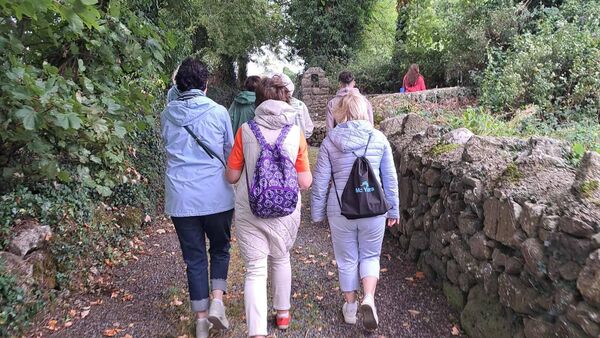
Taking part in the guides walks at Portrun during Heritage Week.
This year’s National Heritage Week has drawn to a successful conclusion with over sixty events having taken place in Roscommon alone this year.
This year’s celebrations took place over a nine-day period from Saturday, August 16th to Sunday, August 24th featuring a rich array of talks, workshops, musical events, and practical demonstrations for young and old alike.
Many of the events attracted many visitors to the county, no doubt suitably impressed by the many fascinating and informative events that took place and also no doubt encouraged to visit the county at a future date.
Many of the events for this year’s National Heritage Week were organised by local volunteer and community groups, supported by Roscommon County Council and its Heritage Office as well as the Heritage Council.
Arguably one of the more popular events that took place during Heritage Week was the walk, talk and boat tour of Portrun Bay, organised by the local Portrun Development Association, in conjunction with the Lough Ree Access For All initiative.
Such was the level of interest in this event, as many as three separate groups, numbering over thirty people per group participated in this local event, which began with a guided walk of local ancient sites in Portrun followed by a boat cruise of Lough Ree.
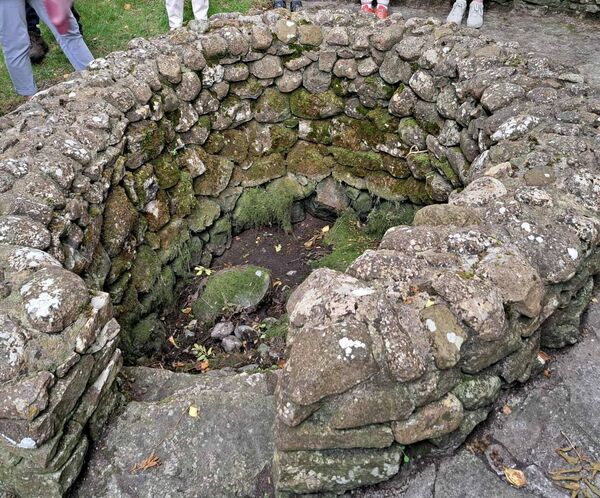
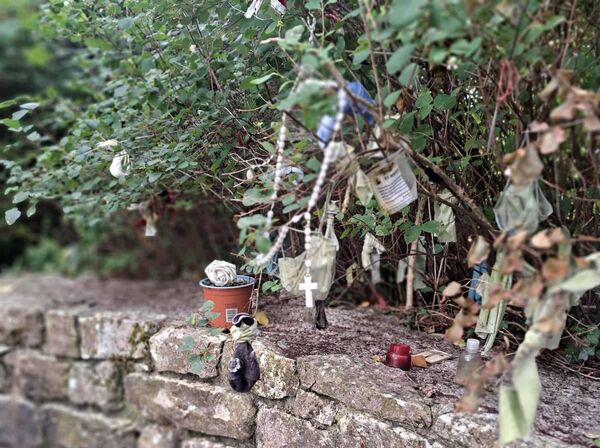
Groups began with a visit to St. Dermot’s Well, a beautifully restored Holy Well set in the heart of Portrun. Led by guide Elaine Conroy of the award winning Rathcroghan Visitor Centre in Tulsk, participants learned about the Saint, a ‘teacher, poet and philosopher,’ known as ‘Dermot the Just’ or ‘he without envy’ who later established a Monastery on Inchcleraun or Quaker Island.
Born shortly after the arrival of Christianity in Ireland in the late fourth century, Dermot is thought to have died in the year 504 AD approximately. Among his pupils was St. Ciaran, the founder of Clonmacnoise.
Legend has it that Dermot, on meeting Monks at the site of what became the Holy Well, on one occasion felt sleepy and washed his eyes with the local spring water to revive himself. And so the local Holy Well was born, a site reputed to have cures for eye ailments.
According to Elaine, the well took on almost mythical qualities, known as a liminal point between this and the next world. The site also became a site of pilgrimage for mass Clan Gatherings, among them a gathering of the O’Conor’s in 1260 and the O’Kelly’s in 1406.
A visit to the nearby Church dating back to the 12th century and the associated graveyard followed. The Church, famed for is delicate ‘lancet style windows,’ was the subject of a 2021 Conservation Report, which revealed evidence of a structure along the Church’s North-West walls and the addition of a late Medieval doorway.
The Cemetery itself has been a local burial ground for over eight hundred years, though the majority of local interments now take place in the nearby Gailey Cemetery where close-by, stands Gailey Castle, in practice a Tower House built in the fifteenth century by the aforementioned O’Kelly Clan.
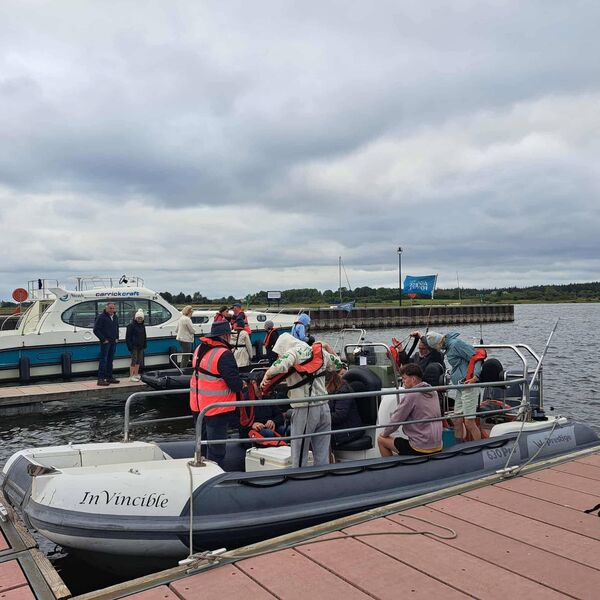
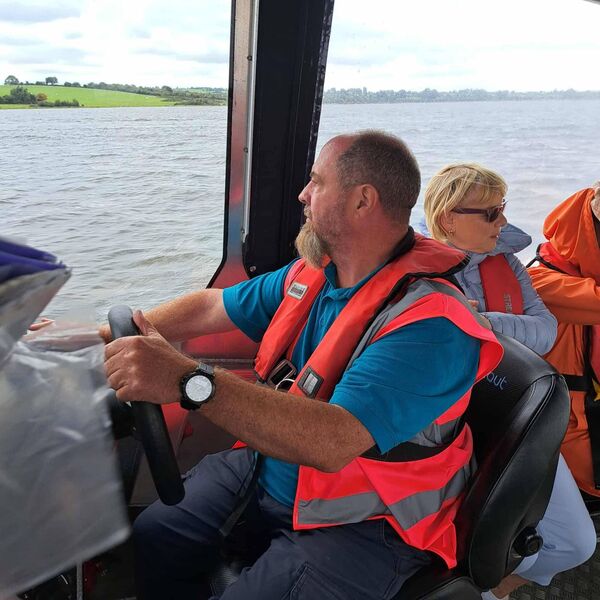
A short hot and skip, so to speak to the local Harbour and a trip on the award-winning Lough Ree Access for All Boat, led by exemplary guide Liam Grimes and his team visitors were given a comprehensive history of Inchcleraun, otherwise known as Quaker Island.
Mr. Grimes said the quality of the water on Lough Ree “is as unspoilt today as it was one thousand years ago. For that, great credit is due to our local authorities (of Roscommon, Longford, and Westmeath) who manage the water.” As recently as 1953, 253 people lived on the islands of Lough Ree, which number 52 in all, an island for every week of the year. Inchcleraun has a unique and colourful history, beginning with Queen Meabh who in the year 50 BC visited her sister on the island and where legend has it, she died, at the hands of a slingshot, using a piece of cheese fired by her nephew!
Later in the sixth century AD, St. Dermot or St. Diarmuid set up a monastery on Inchcleraun Island or what today is commonly referred to as Quaker Island, of which there are the remains of seven Churches, including the ruins of a site, where it’s believed St. Ciaran who went onto found Clonmacnoise studied under St Diarmuid.
Today, Quaker Island is privately owned and has for most of its history been in the hands of the O’Farrell family. For a time, the island was occupied by those of the Quaker religious persuasion, hence its name, of which one member of that persuasion, Edward Fairbrother, lived on the island for 70 years in the 1800’s.
In more recent times, the island was the subject of much intrigue as ancient stones were controversially removed from the island and brought to Boston College in the USA. However the stones were soon returned to Ireland, but not to the island, but instead are in the custodianship of the Office of Public Works, where it’s understood they are now in storage in Galway.
hTAs the boat trip concluded its journey, the touring party were alerted to the presence of Gailey Island, a stronghold of the O’Kelly Clan before the arrival of Cromwell’s forces. During their residence, the O’Kelly’s held major concerts or events, where it’s understood the concept of what we now know today as the ‘Fleadh Cheoil’ first emerged!
After such an exhilarating tour, participants were treated to light refreshment by Portrun Harbour by members of the highly efficient organising committee. For one of the Committee members Anna May Gannon, the tours showcased much of Portrun’s hidden gems.
“We were delighted with the response to our tours, which were fully booked out. We started with the intention of providing two but ending up providing three tours, such was the level of interest. Now more than ever, there is a growing awareness of the rich history of Portrun, which we as a Committee will continue to highlight and promote,” says Anna May.
Reflecting on this year’s events which formed part of Heritage Week, Roscommon County Council Heritage Officer Nollaig Feeney commended all of the communities who organised and participated in this year’s events.
“The extensive range and breath of events for this year’s National Heritage Week has surpassed anything previously organised. I’m very grateful to the many local voluntary and community groups who support National Heritage Week with great passion and enthusiasm.
“Roscommon County Council’s Heritage Office will continue to support local and voluntary groups in promoting their rich heritage and folklore, which our county possesses in abundance. It is the to the credit of all groups that this year’s Heritage Week proved such an outstanding success, causing many people to reflect and cherish their rich heritage,” said Ms. Feeney.