County Roscommon parish priest retires after 52 years of service to the Church
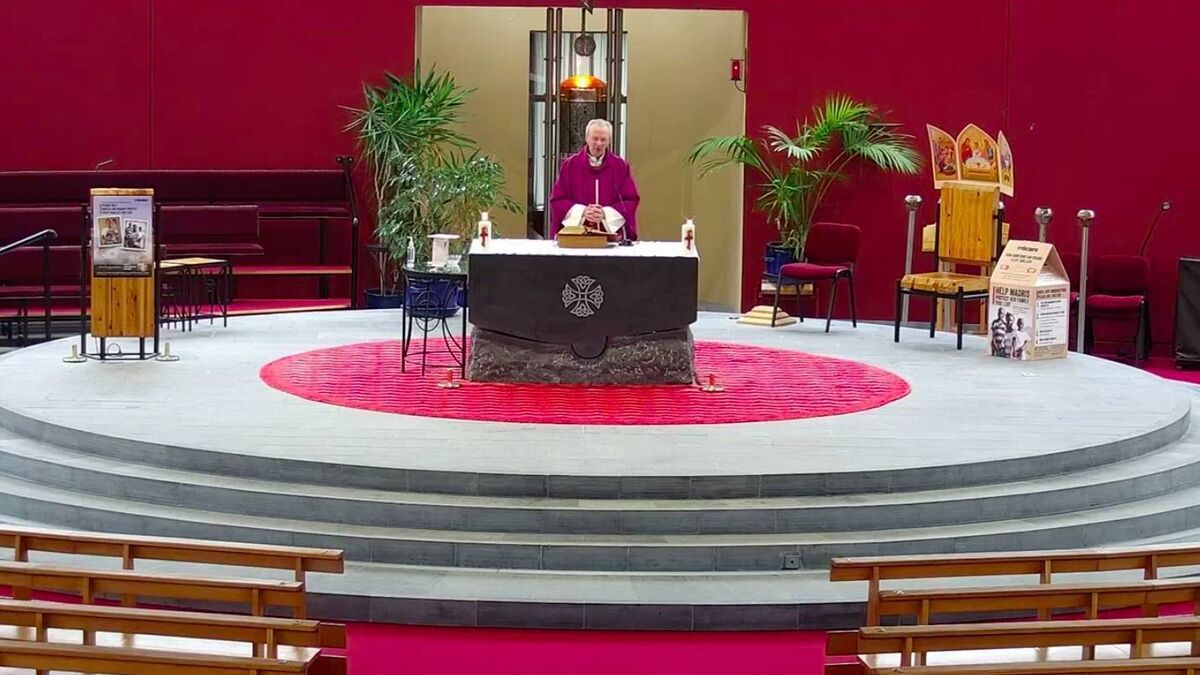
Canon Gerry Hanly celebrating Mass before an online congregation only at St. Joseph's Church, Boyle during Covid.
After 28 years as parish priest in Boyle and 52 years serving the people of Sligo, Athlone and Kenya Canon Gerry Hanly has retired.
The Elphin native who has given over a half a century of service to the church is looking forward to “just being Gerry Hanly” in his new home at Abbeytown, Boyle and taking some personal time before making any future decisions.
As he looks back on his time as a working priest, he recalls life growing up on the family farm, attending boarding school in Summerhill, attending the Irish College in Rome, his ordination and the subsequent parishes in which he served.
Canon Hanly, son of the late Doctor Mark Hanly and his wife Angela (nee Kelly), was born in November 1950. He has two older siblings, twins Vincent and Jacquline and younger brother Gerry. The family resided at Smithhill, Elphin and he attended the Convent of Mercy School in Elphin and later moved to the boys’ primary school. He recalls that, “life was good” during those early years. “It was a very different world. Television didn’t exist and we had a lot of fun. As we got older we helped out on the farm.”
He went onto second level education as a boarder at Summerhill College, Sligo, which he said was “tough going”, recalling always being hungry “but at the age you have a great appetite,” and laughing that on the College Feast Day “we were sure to have enough to eat.” This move to being a boarder was a huge change for him. His father had died just beforehand but he added, “We just got on with it.” After his Inter Cert he thought about entering the priesthood but didn’t really dwell on it. It wasn’t until his Leaving Cert year that he began to think of it more seriously.
In 1968 he was offered the opportunity to go to the Irish College in Rome and so began the start of his journey to becoming a priest. At that time Maynooth had achieved university status and he did not have enough points to be accepted so decided to grab the “great opportunity” that Rome offered.
He lived at the Irish College and adapted to life quickly as he was used to being a boarder from his time in second level education. The first two years of studies were conducted through English, followed by the next two years in Italian and Latin and the final two completed again in English.
Following this he was ordained on June 23rd, 1974 by Bishop Dominic Conway in the Cathedral of the Immaculate Conception in Sligo.
He celebrated his first Mass the following day in his home parish of Elphin.
He then went on to be appointed curate in Highwood in the parish of Geevagh, Sligo.
He enjoyed life there as it was a small parish where everyone knew everyone. He recalls looking over Lough Arrow on a beautiful summer’s evening and reflecting that “this was good time.” He also said this position gave him a chance to settle into the priesthood as funerals and baptisms were challenging but this appointment also gave him an opportunity to learn.
It was also the first time he lived on his own so he had to learn to fend for himself, admitting initially dishes were piled up in the sink. “I have learned since,” he joked.
In 1977 he was appointed as curate to the Cathedral of the Immaculate Conception in Sligo and this was a much larger parish with areas assigned to the various priests. His had quite an elderly population and he said he had three funerals in one day with two to three funerals a week not being unusual. He resided in St Mary’s with a number of other priests but added that priests were always coming and going. He also got involved in the youth club and various other groups.
After seven years he volunteered to be moved and opted to administer in Kenya. This was a complete change for him as at times he had no water or electricity and language was also an issue.
This move was part of an agreement that the Diocese had with Kenya to send out priests to help in the country.
His mission was to take four years, in blocks of two. He firstly arrived in Nairobi and then a few days later made his way to the diocese of Kitiu.
He recalls leaving the bright lights of the city and then noticing the tarmac on the road gradually running out to just clay and electricity poles giving way to arid countryside.
“Life was fairly conformable and if we didn’t have things we learned to work around them.” Houses and the church itself were very basic but the people he said “were lovely, open and friendly.” Hunger was an issue for many, not to the point of famine, but they depended on rain falling at the right times for their crops in order to survive. The church had a store of grain and they would often distribute this to help those in need.
Getting about was also difficult and he and his fellow priests travelled around on motorbikes.
“It was little things that were frustrating. But I read a lot at night by a tilly light,” and this helped ease life just that little bit.
Two years later he returned to Ireland for a three-month sabbatical where he spent time at home in Elphin, meeting up with family and relations.
Following this he returned to Miambani. Similar to life in Kitui he said the toughest part was climbing the hilly and mountainous environs in order to get to the churches.
Although times were tough he was always fully committed to his four years in Kenya and added that “there was always an end in sight.” He returned home in 1989, taking a break, and undertaking an educational course. At the end of that year he was appointed curate to SS Peter and Paul in Athlone. “It was back to the old Irish ways,” he said.
He spent nine years serving the people of the parish until he was approached about becoming parish priest in Boyle.
At the beginning he was quite hesitant as he was considered young for the role at 48 years of age.
It was a lot of responsibility, but many people helped in various ways. Initially he had two priests to assist but this has now been reduced to just one.
As he began life in Boyle the two secondary schools were amalgamating, the copper was cracked in the church roof which was leaking, and the heating system was erratic.
The people of Boyle made him very welcome from day one.
Applauding the great music, wonderful choir and folk groups in the parish, he highlighted that Christmas and Easter are also wonderful, happy occasions, paying tribute to the contribution of the late Frank O’Mahony.
When he arrived in 1998 many people were unaware he was celebrating the silver anniversary of his ordination. However, that changed when it came to his 40th jubilee when a huge crowd from the parish got to together to mark the occasion despite his request “to keep it small”.
It has been one of the highlights of his time in Boyle followed closely by the celebrations to mark his golden jubilee in 2024. He has carried out hundreds of funerals, weddings and baptisms and admits that “although I don’t know everyone I know quite a few.” He added: “The people are nearly family, Boyle is home for me. It has lovely people and it is a lovely town to live in.” Despite thinking briefly of returning to Sligo it was his love of the North Roscommon town that won out in the end.
The life of a priest can be a difficult one and looking back Canon Gerry said that deaths by suicide and the deaths of young people and children are extremely difficult to deal with as indeed is any tragic event.
His own health has suffered in recent times and when he hit the age of 75 it was one of the driving factors that influenced his decision to retire.
As to the future of the Catholic Church in general he believes it may become “smaller but better.” He added that there are many people of deep faith. “We are Christians and we have to look to Jesus; the Church is just the institute of that.”
He has seen figures dwindling in his own parish and stated that this was “across the board” and covers all age groups. He admits that “there have been some dark days which were not handled well.” Fewer people opting for the priesthood has been something very evident in his own time. “When I was ordained I was one of five ordained in Elphin diocese that year. The last ordination of a priest in the parish was in 2000,” he highlighted.
His life has been one of resilience, meeting all types of challenges and offering 52 years of his life to the Church.
In summing up how he feels as he officially retires he said: “I have no regrets as my life as a priest. I am glad I did it. A learned a lot from people and I learned a lot about myself.” Perhaps best of all on a very personal note he said he was looking forward “to being Gerry Hanly, not just Fr Gerry Hanly.”