End of an era as Roscommon man hangs up his classic phone box business
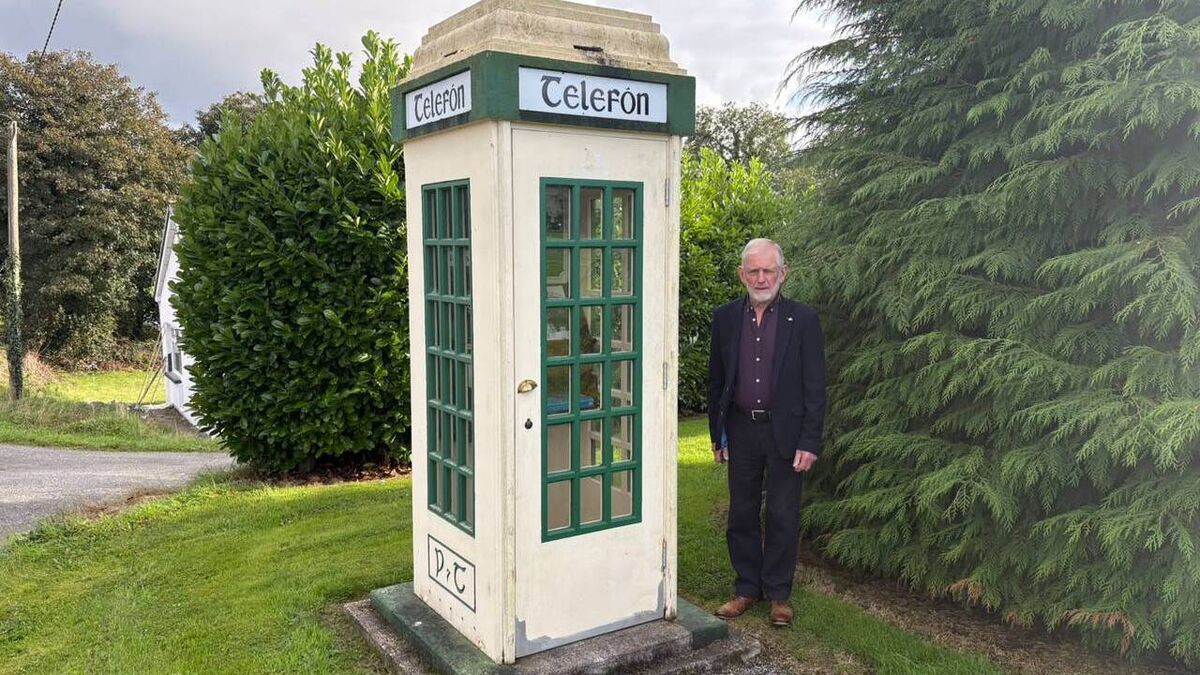
Sean Connaughton, from Carrowbehy near Castlerea, who made iconic phone kiosks, has decided to retire. When he sells the few remaining ones he has in stock they will no longer be available. Pic: Telefon.ie
The last man building traditional telephone boxes in Ireland is hanging up on his business in County Roscommon.
Sean Connaughton, who makes the iconic phone kiosks from his home at Carrowbehy, near Castlerea, has decided to retire. When he sells the few remaining ones he has in stock they will no longer be available.
Sean started a construction business in 1973 and his career of building houses, among other projects, came to an end in 2017.
The idea for building the traditional Irish telephone box was prompted by his wife, Marian.
“My wife used to say to me ‘I would love one for the garden’. I said to her if I ever retire I’ll make you one.” It became an ideal business working from home during the Covid pandemic.
His shed became a hive of activity, making the iconic phone kiosks and he produced about 40 of them.
“These ones I make are the exact replica of the original,” he said.
Sean started making them without the original plans. “I came on an original box in Castlerea and I got all the measurements from that.” “There was a woman who had a post office across the road from it and I said to her you’ll see plenty of me around here, because I’m going to make one of those boxes. I might be up and down a few times and she said that’s okay,” he said.
But could somebody else in Ireland pick up on his business to build an authentic telephone box?
“I doubt if they would bother. They won’t go that extreme to make them . They might make one that kind of looks like them, but they won’t be real,” he said.
The first public payphone was installed on Dawson Street in Dublin in 1925 and then rolled out across the city in 1932, in time for the Catholic Eucharistic Congress.
It is estimated that eventually Ireland had about 3,300 of the iconic cream and green coloured public phone boxes.
But the mobile phone revolution made them no longer financially viable and Eir started to dismantle them.
Some kiosks were donated to community groups as sites for defibrillators, a book exchange, or a tourist information hub. Eir says dozens are now electric vehicle charging points.
You can see one of the traditional phone boxes at the Derryglad Folk and Heritage Museum in South Roscommon.
The museum’s founder, Charlie Finneran, says it is amusing when visiting children try to use the classic telephone.
“Not a clue,” he says. “We have school children here and they wouldn’t have a clue how to dial the number. All they’re interested in is the mobile.” Charlie remembers how the public phones were important to communities.
“In its time of course it was the only contact. They would be used to phone doctor and everything.” The classic kiosks were a technological sign of Ireland becoming more modern.
“They were hugely symbolic items in a society,” according to Paul Connolly, an author of books about the history of Roscommon, who comes from Mount Talbot.
“I remember the one at Four Roads, the one nearest me and there would be queues there a lot of the time,” he recalls.
“In mid-century Ireland they were massively important. Back then letters took three or four days. Maybe just some of the big businesses in a town had a phone.”
He notes that the installation of a phone kiosk transformed an area.
“When the phone box arrived into a community, into a village or into a town, it opened up the outside world to them.” “I’m 52 and for the first 10 years of my life we did not have a phone.” Paul, who studies Roscommon’s history, posts his knowledge online.
“I share a lot of old photographs on my Mount Talbot Facebook page and in the background, in a lot of the photographs from the fifties and sixties, are phone boxes.“ The Roscommon author compares the loss of phone boxes to the village water pump.
“When piped water came to the household we forgot about the village pump. I think the value of them wasn’t appreciated until they were gone, unfortunately,” he notes with regret.
Before automated exchanges were introduced the phone box was a sign of jobs being created locally, as Paul Forde reflects in the Voices of Boyle podcast.
“Above the post office for decades sat the Boyle telephone exchange, once staffed by up to 40 telephonists who manually connected calls. It was one of the most sought-after employers in the town, offering steady government wages.” The jobs were axed when the exchange went automatic in 1984.
Michael O’Boyle, a conservation architect, who has worked with the Historic Towns Initiative in Roscommon, thinks the iconic kiosks could have been retained in many locations.
“Most people didn’t have a phone, the phone box was a very instantly recognisable design and was to be found in every town, village or major crossroads across the country.”
“They were undoubtably a feature of the landscape right up until the mid to late nineties, with the advent of the mobile phone.”
“There was a slight move towards a more modern design, but the classic cream and green phone box, with the Gaelic lettering ‘Telefon’ up above, was a feature and it’s a terrible shame to see it go,” says the conservation architect.
Michael also thinks it was a mistake to remove them. “It’s interesting to note that the beginnings of the disappearance of the phone boxes pre-dated the advent of conservation planning legislation by about two or three years. Conservation legislation came in on the first of January 2000. Prior to that there was no formal way of protecting, not just buildings but other important features like phone boxes or post boxes.”
“If had happened ten years later I think that Eircom would have been obliged to liaise with the local authorities, or probably on a national level with the Department of Heritage, to come up with solutions to keep a certain number of these boxes in key locations, as an important tangible reminder of the social history of the twentieth century. The same way that post boxes are protected.”
Michael, who has been involved in street conservation projects in Boyle, Roscommon Town, Castlerea and an urban regeneration plan in Ballaghaderreen, says it is not too late to replace phone boxes, as a reminder of our heritage.
“It would be very appropriate that phone boxes went back in locations where they historically stood and it does restore a feature that should never have been removed. I would be a little more lukewarm about randomly putting one in a new development that never had one.” He also thinks architects could play a role in restoring the classic phone box.
“There is a lot of upgrading going on and a lot of money being spent on pavements, street furniture, benches, lighting and so I think there is potential to incorporate one or two of these as a reminder of times past and the social history of how society worked,” he says.
Gerard Delaney, a historian in Ballinrobe, remembers how the phone boxes were important in rural Mayo.
“They saved a lot of journeys, looking for a doctor looking for a vet,” he recalls.
“The average farming family in Ireland would have used the local phone box at least once a day, until the advent of telephones in houses, which didn’t really happen until the 1970s.” He also remembers how some people avoided paying for incoming calls.
“When emigration happened a lot of people overseas would make return charge calls to these phones, which got abused. Because a person would take up the call and say yes I’ll reverse the charges and this wouldn’t be known to the operator in the United States, or to the operator in England or wherever. Quite a large bill was run up that no one was ever going to pay,” he said.
Sean Connaughton has enjoyed making the iconic phone boxes from his shed, at Carrowbehy, but has now decided to retire.
An important operation for the history of Roscommon and Ireland is coming to an end, as he packs away his tools, with regret.
“If I was younger I would keep making them. You wouldn’t sell a heap of them. You’d just sell the odd one. They’re just like the vintage car. “It’s the odd village that loves them.”
Modern Ireland has seen the end of roadside petrol pumps, parish water pumps, the loss of old post boxes and the demise of the iconic phone box.
Sean has made dozens of the traditional telephone boxes and preserved some of our country’s history, but that one man industry, based in a shed in Roscommon, is coming to an end, as he retires.