Man jailed for involvement in ‘sophisticated’ €730,000 cannabis growhouse operation
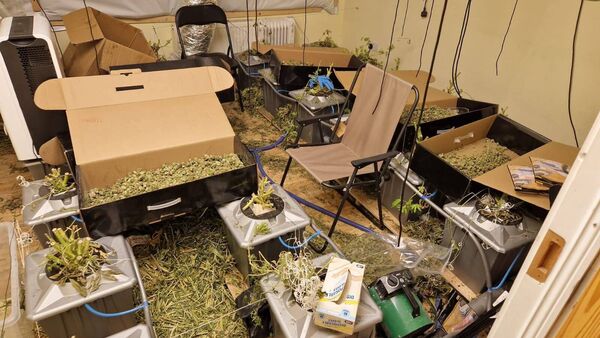
Inside the Loughglynn growhouse.
A man who hid in the attic insulation of a “sophisticated” growhouse while gardaí searched the property two years ago, has been jailed for a total of 20 months.
Edgaras Paulaskas (34), of Greenshank Street, Aston Village, Drogheda, County Louth, appeared before Judge Kenneth Connolly at Roscommon Circuit Court for sentence.
His co-accused, Rimas Abrachimovas (42), with an address at Laburnum Dive, Termon Abbey, Drogheda, County Louth, was jailed for three years in October, while another co-accused, Evaldas Juknevicus (42), with an address at Millbrook, Portlaoise, County Laois, received a five-and-a-half year sentence for his involvement.
Suspicions were raised in March 2024, when gardaí noticed the blinds of the unoccupied house in Cloonmullen, Loughglynn were always down, with all the lights switched on at night.
A search warrant was executed on April 9th, 2024 and, when gardaí arrived, Mr Paulaskas and Mr Juknevicus concealed themselves in the insulation of the attic, while Mr Abrachimovas hid on the ground floor of the property.
Gardaí executing the warrant came upon “a sophisticated growing operation”, which saw cannabis plants in every room of the house, including the attic, which had been fitted with a complex hydroponics system to water the plants.
In total, gardaí discovered 170 plants, the majority of which had been harvested and placed in bags. 36.33kg of cannabis was seized, with an initial estimated street value of €725,940.
However, a report from an independent expert revealed the actual value of the cannabis to be €319,030, as gardaí had uncovered 15.951kg of female flowering heads, 18.51kg of ground leaf, and 1.8kg of seeded cannabis.
Desmond Dockery SC for the accused, reminded the court that his client had entered an early guilty plea. Mr Paulaskas’ job was to feed and water the plants and he was at the “lowest end of the chain” in the organisation.
He cooperated fully with the investigation and denied any knowledge of packaging or sale or supply, the court heard.
“He was addicted to cannabis and was given small quantities of the drug in exchange for his assistance. He was promised €6,000 to €8,000 on completion but he didn’t receive that,” said Mr Dockery.
A probation report, despite a prior conviction for similar offending, put him at low risk of reoffending in the next 12 months “on the basis he has managed to abstain from cannabis use for over a year”, Mr Dockery added.
Mr Paulaskas continues to engage with Narcotics Anonymous and is in full-time employment as a truck driver.
He has two boys, aged 12 and 10, with his long term partner, with whom he has been since they were 16 years old. She works part-time, Mr Dockery outlined, but suffers with a heart condition.
The probation report assessed Mr Paulaskas as being suitable for community service but said continued supervision by the probation service would no longer be required.
Mr Paulaskas moved to Ireland from Lithuania 16 years ago and has worked consistently ever since, said Mr Dockery.
He is engaging consistently and meaningfully with psychotherapy and a letter from his employer verified that they have a contract with him to carry out the delivery of concrete.
“The quantity of drugs was substantial indeed. This was a seriously professional production and he also has a prior conviction for similar, for which he got an 18 month suspended sentence from a court in Monaghan,” said Mr Dockery.
“But this is also a case where there is very strong mitigation. He has proven consistently that he was, and is turning his life around. I’m asking the court to show leniency to this man in recognition of his efforts so far, and also the confidence the probation service has in him.
“They believe he can stay on the course he has set for himself. He pleaded guilty at an early stage, he has a partner, a stable background, everything to live for, and I’m asking the court to contemplate the prospect of a fully suspended sentence.” Judge Connolly agreed that Mr Paulaskas has “done very well indeed, has taken all of this very, very seriously, and seems to have rehabilitated himself”. He noted the accused is the primary caregiver to one of his children with significant learning difficulties in circumstances where his partner has her own medical difficulties.
He noted that Mr Paulaskas was one of three co-accused and recalled that the first co-accused, Mr Juknevicus, was sentenced to seven years in prison with the final 18 months suspended, “and then, essentially, a deportation order”.
The second co-accused, he recalled, was sentenced for cultivation, “which is the same charge as this accused”, and received five years in prison with the final two years suspended for three years.
He noted there are varying calculations as to the value of the drugs seized but stressed that, regardless, this was “a huge amount of drugs”.
“How is he distinguishable from the co-accused, that he’s entitled to a suspended sentence, particularly when he’s had a previous suspended sentence?” Judge Connolly asked.
The court heard that Mr Paulaskas spent six weeks in custody last year, which made a deep impression on him, and that urinalysis results had come back clear as he had remained off cannabis.
Turning to sentence, Judge Connolly noted that Mr Paulaskas admitted to his role and told gardaí he had become involved because he was known to have a good knowledge of cultivation, but he was not the organiser and was to receive a modest payment for his work.
He has three previous convictions, including no insurance, drug driving, and the cultivation conviction from Monaghan Circuit Court, which saw a suspended sentence of 18 months imposed on January 21st, 2022.
“It is a very aggravating factor that this detection was made just after the end of that suspended sentence,” said Judge Connolly.
However, he noted the very early guilty plea, cooperation at interview, “relatively” full admissions, as well as the fact he was at the “lowest level of the enterprise” and has come to no subsequent adverse attention.
He was given the opportunity of a suspended sentence previously, Judge Connolly noted, and he has gone to great lengths to rehabilitate, but he “should have learned his lesson after the first detection” and so he could not impose a suspended sentence on this occasion.
He set a headline sentence of five years and three months imprisonment but, taking into account such mitigating factors as an early plea, an excellent probation report and an excellent work history, he reduced the sentence to three years and eight months.
“I would like to impose a fully suspended sentence, but I feel this is not appropriate,” said Judge Connolly.
He suspended the final two years of the sentence for four years, leaving 20 months to be served. The conditions of the suspended portion of the sentence include that he remain drug free and have no association with controlled drugs.
*Published as part of the Courts Reporting Scheme.