Red bench unveiled in park in tribute to young woman living with heart condition
By Rebecca Black, Press Association
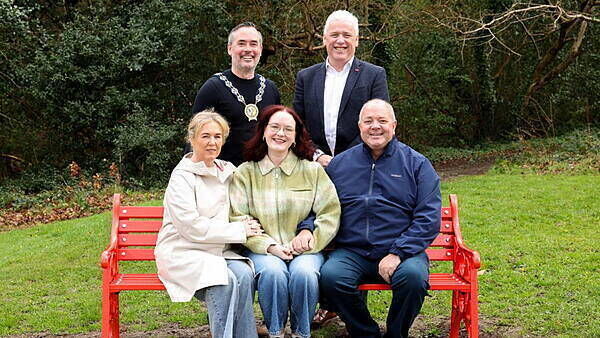
A distinctive red bench has been unveiled at a Co Down park in a living tribute to a young woman with a heart condition.
Caoimhe Loughran, from Newry, was just 17 when she first experienced symptoms.
She had been fit and healthy throughout her youth, even playing Gaelic football to county standard.
But she described starting to suffer from exhaustion and a fast heart rate – feeling as though her heart was “pounding” through her chest.
She went on to suffer more severe symptoms, including numerous collapses, and was told she had an electrical conduction disorder which was causing her heart rate to go dangerously slow.
She was fitted with an implantable loop recorder which detected pauses in her heart rhythm, and when she was 20 received a pacemaker.
The bench in her name has been placed in Kilbroney Park, Rostrevor, and Ms Loughran said it means a lot to her as a “reminder of how precious life is”.
She said she wants to share her story to help others, describing a “long battle trying to get heard”.
“I do feel I was dismissed for being a woman with the belief that my symptoms were down to my menstrual cycle or the pill,” she said.
“I was told I had anxiety on numerous occasions as well… I just felt like no one was listening to me.”
She recalled how, despite being so active, people started to remark on her complexion, looking pale and how dark her eyes were.
“I just simply was not well, but no one could understand why,” she said.
As Ms Loughran started university, she said she was “struggling to live a normal life like all my friends who were happy and healthy”.
“In September 2022 I went into my placement year of my undergrad – that’s when it was getting to be the worst that it ever had been,” she said.
“In the first week of my placement, I ended up collapsing at work, I completely passed out – broke my glasses, my tooth came out and I had a bulge on my head.
“It was then that that my doctor decided to put in the implantable loop recorder – so they could see what was happening and possibly get a diagnosis.”
Two months later, episodes in her sleep led to Ms Loughran having a pacemaker implanted.
“I remember when I woke up the next morning, I had loads of phone calls from the hospital saying you need to come in right away,” she said.
“I had ‘heart block’, it’s hard to describe fully but basically what was happening was the heartbeat would generate from the top and when it got sent to the bottom it wouldn’t fire back up.
“So that there was like a break in the circuit when there was a pause between beating – hence I started collapsing.
“When I was sleeping that particular night it was getting progressively longer, the first pause was maybe four seconds, and then the next pause was like 11 seconds and then the next 20 seconds – the pauses were becoming too long.
“They theorised that if they didn’t intervene, I probably would end up just not waking up as it potentially could pause too long and then not start beating again.”
She said at that age she struggled to take it all in, not being able to relate to the older demographic that she thought pacemakers were used for.
“I felt very sorry for myself at that time. It was just very frustrating and quite shocking, I felt really alone to be quite honest and very fearful,” she said.
“I had so many questions about my future and children that I would love to have in the future.
“I was kind of grieving this future that I thought I was going to have and trying to establish, what is it going to look like now and how different it was going to be.”
Ms Loughran paid tribute to her family, friends and boyfriend for their support, and giving her the strength to have a positive outlook on life.
She said that since having her pacemaker fitted her life has “improved considerably” and she is no longer on medication.
“I would say within about a month or two of getting my pacemaker fitted, I could really notice, my complexion was better, no palpitations and so much less tiredness, I was nowhere near as fatigued. I was just looking and feeling a lot better,” she said.
“I have a device at my bedside that sends data to the medical team, and if I am having any episodes, I can press a button, and I receive phone calls quite regularly to check in on me as well. But right now, it’s just me and my pacemaker and I’m really happy with that.”
Ms Loughran graduated in 2024, and has gone on to complete a Masters in public health, specialising in heart health.
“I am so committed to make a positive difference with research, evidence-based recommendations and guidelines; always just having the patient at the centre of the service and the work is something that I feel so strongly about,” she said.
The British Heart Foundation has unveiled 65 red benches across the UK in tribute to those living with cardiovascular disease, including heart attacks.
Fearghal McKinney, head of the charity in Northern Ireland, said: “Caoimhe’s story shows the true reality of living with cardiovascular disease, and we are so grateful that she is courageously sharing her experience to help others.
“Despite being one of Northern Ireland’s biggest killers, our new findings show cardiovascular disease is still misunderstood or not taken seriously – and that those living with it face judgment and challenges.
“By sharing the stories of people who live with cardiovascular disease on our iconic red benches across the UK, we hope to start more conversations that change dangerous misconceptions.”