County Roscommon man gives a lifetime of service to the GAA
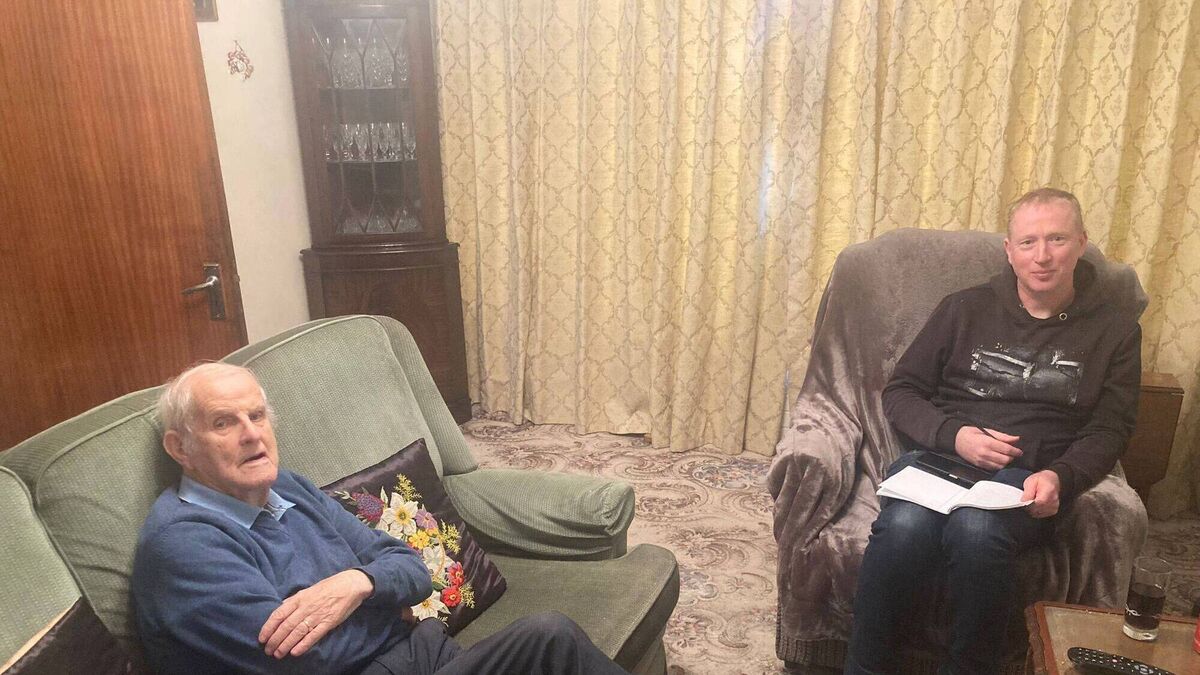
Roscommon Herald reporter Kevin Egan sits down with Phonsie at his home in Ballyforan for the Festive Herald.
Throughout the long and storied journey of the Gaelic Athletic Association, there have been plenty of famous figures that have etched their names into the history books as driving forces along the way. We think of Maurice Davin, Michael Cusack and the other pioneering figures that attended that famous meeting in Hayes Hotel 135 years ago, as well as Luke O’Toole, Pádraic O Caoimh, Seán Ó Síocháin and Liam Mulvihill, the four men who filled the General Secretary role between them for 106 years.
On a more local level there have been individuals like John Costello in Dublin, Frank Murphy in Cork and Ned Quinn in Kilkenny, who were central figures in their respective counties’ success stories, seizing the moment to ensure a bountiful harvest was reaped when conditions were favourable.
In Roscommon too, men like Douglas Hyde, Dan O’Rourke and Donal Keenan have left each left indelible marks on this most remarkable of sporting movements, and across the 32 football and hurling clubs of the county, there are plenty more individuals who have been central to the development and success of their local outfit.
However as any mechanic will tell you, a machine cannot run on fuel alone, it must also have oil, to keep the independent parts moving. The engineering and the chemistry will get the plaudits, but even the Ferraris, MacLarens and Red Bull Honda cars that recently finished up the 2023 Formula One season in Abu Dhabi wouldn’t have gotten far without the help of their respective oil suppliers.
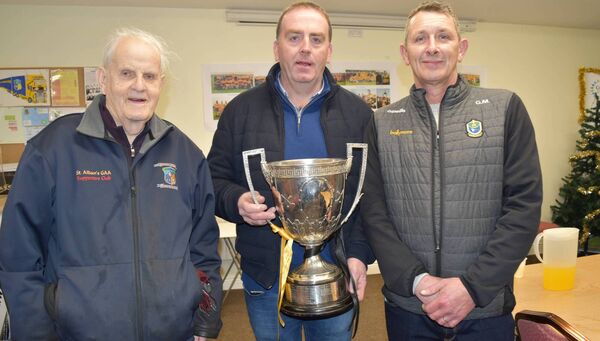
A three-hour conversation between this reporter and Phonsie Tully, the Ballyforan man who has poured his heart and soul into the promotion of gaelic games for the vast, vast majority of his 89 years of life, is unsurprisingly an immensely enjoyable and informative way to spend an afternoon.
Tully, a retired teacher who says that his life on the GAA’s playing fields, on their terraces and in their meeting rooms “meant everything to me”, is the type of man that many people would describe as ‘the lifeblood’ of the association. As I walk out of his home, it’s hard to escape the conclusion that he could just as easily be described as the oil that keeps the engine moving so well.
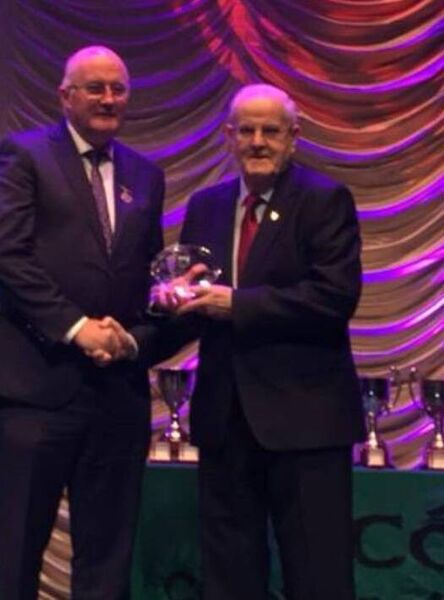
The distinction between Phonsie and some of those vaunted names above is that while most of those figures acted as leaders, using their authority to drive the GAA, either nationally or locally, to where they felt it needed to go, Phonsie didn’t seek power.
When it landed on his shoulders nonetheless, he invariably sought to give it back to the units and the members where he felt it truly lay. His ultimate loyalty has always been to the ethos and the spirit of the association, and how those ideals manifest in the administration, the rules and the by-laws that serve as the foundations of everything that follows.
We’ll return to his life story shortly, but an anecdote to illustrate Phonsie’s style is demanded here, and the obvious one that springs to mind is the 1989 Connacht minor final between Roscommon and Galway in Castlebar. For the handful of readers who don’t know the backdrop, the story was that Roscommon trailed Galway by a point in stoppage time and were awarded a penalty, with Peadar Glennon standing over the ball to take it.
As Glennon prepared to begin his run up, in charged Shane Curran, who fired the ball to the roof of the Galway net, ushering in wild celebrations in front of a big crowd (the Connacht senior final was on afterwards) and the presentation of the cup.
However it later transpired that the referee had disallowed the goal since Glennon was, naturally, standing inside the 20m line when the kick was taken, and so the score was ruled out and the match was formally recorded as a 2-8 to 0-13 win for the young Tribesmen.
“We discovered before we went home that we’d have to give back the cup” recalls Phonsie, who was Roscommon County Board chairman at the time.
“I was going to Tipperary that Sunday evening, my wife’s brother was a priest in America and he was staying in Newport.
“Paddy Francis Dwyer was the secretary and he told me to go, because he said it was enough for one of us to be answering questions. I was back on Monday evening and all hell had broken loose in the meantime. So on Tuesday I decided that we were going to call a meeting of the county board, and they said we were mad. But I said, let’s let people have a say. The mothers became involved, backing their sons, and rightly so, and we decided to let some of them in to have their say” he explains.
“There was a proposal not to field a senior team” he says, referring to the senior final replay against Mayo that was due to take place. “I said we should but not to steward it, because the game was in the Hyde. So we debated all evening, we let everyone who wanted to speak, speak. It went on so long, and eventually Eamon Campion stood up and said that this has got a very good hearing, and he proposed that it be referred back to executive committee for them to make the decision, based on what we’d heard”.
Cue some backroom diplomacy with the Connacht Council, leading to the arrangement of a refixture, as a opposed to a replay, which proves crucial.
“Lorcan Dowd had been put off in the original match, but because the original game didn’t count, that red card was wiped” and sure enough Roscommon go on to win their ninth ever minor title in that refixture in Castlebar.
Of course, in the story of Phonsie Tully’s GAA life, this is just one chapter, halfway through the tale. And the backdrop to the story is his love of hurling in particular, though that was an accident of geography, to a certain extent.
His father, John Tully, was born in Cavan – not exactly a hurling heartland – but his career with an Garda Síochána took him to Ardrahan in Galway, where Phonsie was born.
“If you didn’t hurl in Ardrahan you were sick” was how Phonsie describes growing up in the South Galway parish.
“During the war, we used to play in the street because there was no traffic. I saw one football match in Galway, it was two junior teams and they just put their hurls down and started playing, but football is a foreign game down there”.
When John Tully moved to Ballyforan, so did the family, but by now, hurling was Phonsie’s thing, and Roscommon hurling were about to welcome one of their most famous sons into the fold.
“I eventually made my way down to Four Roads one Sunday, I suppose I was 13 years of age. I played minor with Four Roads and with the county in 1948, 1949, 1950, 1951 and 1952” he says.
There weren’t any famous results for those minor teams, though he does speak of one near miss in St. Coman’s Park where Roscommon drew with Galway before losing the replay in Ballinasloe, and there’s no doubt that even now, over 70 years later, the sense of regret at that missed opportunity still rankles.
Passage through to the adult ranks was seamless, and it was a time when the Roscommon hurling championship was somewhat chaotic. After St. Coman’s doubled up in 1951 and 1952, it wasn’t until 1964/1965 (Roscommon Gaels) that another team managed to retain the county title. In terms of participation too, Tully remembers it as an era when there where green shoots in lots of place around the county, but the hurling flower just didn’t quite get to blossom fully.
“An odd time you’d have had a team for a year, Boyle might have had a team and Castlerea came and went. They should always have had a team, they had the mental hospital and there were lots of good hurlers working in there.
“Hurling was always strong in Four Roads. Now they might win a county championship and then not bother about the next one, then a couple of years after it they’d come and win it again, that was the way”.
On the pitch, Tully was lining out in both codes, playing football with Ballyforan (or St. Aidan’s, after 1956) and Four Roads. With Ballyforan and St. Aidan’s, he began to take on some administration roles, and just as his hurling on the pitch saw him earn a slot on the Roscommon senior hurling team for several years, so too his smooth and diplomatic way of going about his business saw Phonsie pick up more and more roles off the pitch.
“I was the first secretary of Coiste Iomána and I was that for over 20 years, but I wasn’t involved at county board level. Peadar Earley, Dermot’s father, rang me and he said that there’s a vacancy coming up on the Connacht Council, and would you go for it?
“My first reaction was that I didn’t think I would, but I got a few more calls and eventually I said all right so, and I was voted in.
“I was vice chairman of the county board until Micheál O’Callaghan died suddenly and then I was made chairman. But I was never happy in it, I was only three and a half years in that. Then Johnny Haughey resigned off Central Council and I went on that for years”.
Later in the conversation, Phonsie speaks of how he never canvassed for a vote for any role he took on in GAA administration. When that was allied to his distaste for outright leadership roles, it meant that instead, it fell to other, more established figures to identify where his real gifts lay; the most notable being his ability to understand and interpret the GAA’s often-byzantine rule book.
Add in his complete lack of ego and his respect for the concept of fairness and due process, and it was easy to see why these roles were ideally suited to him.
“There was a committee in Croke Park, a byelaws committee, and I was on that less than a year when the chairman resigned. Seán McCague rang me and asked me if I’d become chairman of that committee, and when I said no, he asked me who would I recommend, so I recommended a brilliant man, Jimmy Treacy from Tyrone. He wasn’t just good, he wasn’t great, we were 15 years on it together sorting out the byelaws of the country.
“People thought we were against the counties and causing problems for them, but it was the opposite. We were almost like a forerunner to the DRA, our job was to make sure that if a county got involved in a controversy, that the rules would stand up”.
He tells one story that illustrates perfectly why he was so sought-after.
“I remember going up to a disciplinary meeting, thinking we have a lot of dirty work to do tonight. I never looked forward to a meeting less, we all felt that going in” he says.
“One player was very arrogant, but there was a Cork man with me on the panel and he said ‘I’d love to nail that lad, but he has right on his side’. I thought that was the right attitude, it was about fair play above all”.
“Now, what he didn’t call us going out the door….” He talks of discussions with Meath County Board and with the Munster Council where what started out as adversarial meetings were quickly smoothed over when his understanding of the GAA’s rules and procedures was brought to bear, and in general, it’s clear that diplomacy was Tully’s plan A, all the time.
“I didn’t believe in fighting with everyone. It was better to talk about things than fight about them, and while some people believed that you got nothing if you didn’t fight for what you wanted, that depended on if you fought the right way.
“If you go about things the right way, your turn will come and their turn will come.
“Things have changed and the GAA is not the same any more. Central Council isn’t nearly as powerful as it was, because so much is being done by the management committee. They come in with a decision and just present it to you. When I went into Central Council, it had a lot more influence”.
In a life spent across every level of GAA administration, there are countless areas where to varying degrees, Phonsie left his mark. Scór, the cultural wing of the Association, was ‘christened’ as such by Tully, while he also played a central role in the decision to bring London into the Connacht senior football championship. The absence of any aspiration for legacy certainly didn’t stop him from leaving many.
Yet through it all, hurling evoked his deepest passion, and there’s no doubting that the sport’s failure to flourish in this county disappoints him, despite all the natural obstacles in place.
“There was a very definite valley period when hurling was at even a lower ebb than it is now. But the standard has definitely gone down a lot, from what it was” is his summary of the current state of affairs.
“When I was playing there were some very good hurlers, most of them local. We had a few blow ins; particularly Galway lads who were working in the mental hospital in Castlerea and they played for Roscommon that way, but then you had the likes of Gerry O’Malley.
“I’d say there wasn’t enough being done at underage. We weren’t getting the best players to play with the county, and it wasn’t fashionable to play with the county either, whereas when I was playing, all we wanted to know was where was the next match and when would I get playing again” he said.
“We had hurling in every club in the county after the ‘Hurling Revival’ in 1965 and 1966, but as soon as the person who was organising it left, it died. St. Brigid’s, Clann na nGael, St. Faithleach’s, Castlerea, they could have had good teams if there was more support locally, and I’d like to believe that this could happen yet. There are players from every one of those areas playing senior club hurling right now, so it’s not like the interest isn’t there.
“We put hurls in every club in the county of Roscommon at the time. The hurling survived as long as the person who took it on was there, but it only properly took off in a couple of clubs.
“We got Pádraig Pearses and we got Oran, but everywhere else that continued to play the game, there was hurling already. It’s not easy to do, it involves significant personnel and expense, and there can be apathy towards it from football people. They’d be afraid that hurling would impinge on the promotion of football, but it didn’t have to be like that”.
Perhaps if those people had gotten to know men like Phonsie, they mightn’t have been so afraid. After all, while there are plenty of football people who would burn all hurls out of fear of the sport permeating their own community, and there can be just as many hurling people who would put a knife through every football, just as Christy Ring famously said should happen to any O’Neills ball that would cross over onto the eastern side of the Mallow-Cork City-Cloyne axis that splits hurling and football country in the Rebel County.
But remember, oil reduces friction. Even on the pitch, the fierce local rivalries that resulted from the proximity of all Roscommon’s main hurling clubs to each other, didn’t influence Phonsie Tully in the slightest.
“The first match I played for Roscommon was in Birr on October 15th, 1955, and then I went teaching in Feevagh the next day. Bernie Connaughton was the Roscommon goalie at the time and they decided at half-time that they’d put me in goal and put Bernie in the forwards, and it worked well.
“The next match we played was in February, and I was in goals in Athleague. Now I wasn’t bad, I was worse than bad. So there were good days and bad days, and there was always that rivalry for the goalie position there with myself and Bernie.
“Four Roads and Athleague would play and there’d be more rows than hurling in it, but after the game, myself and Bernie would meet in the middle to shake hands and have a chat. In Four Roads, they’d be fighting with Athleague on a Sunday then on Monday they’d be down in the shops in Athleague, chatting away. If people love hurling, that brings them together, more than any parish rivalry separates them” he says.
And so we return to the overall theme of the conversation. Phonsie Tully is a Ballyforan man, a St. Aidan’s man, a Four Roads man and a Roscommon man, but above all, he’s a GAA man, who wants to see gaelic games thrive. And while there would be those who would only like to see controlled growth, Tully is more like a conservationist than a tillage farmer, he wants to let nature take its course.
The only hint of partisan emotion comes when he refers to his family. He cites how his incredible life within the GAA wouldn’t have been possible without the unstinting support of his wife Eithne, herself a devoted GAA supporter from Galway.
His son Gerard is now part of Central Council through the Higher Education committee, while Adrian had a long and successful hurling career with Roscommon and Four Roads as well as winning a range of underage and adult medals with St. Aidan’s, and he now continues to support the growth of the game through hurling and camogie coaching in Roscommon Gaels.
However even Phonsie’s admiration for his two sons and their commitment to the cause pales into insignificance when compared to the smile that crosses his face when he points out a picture of his grand-daughter Molly, who is just starting out on what’s sure to be a lifelong gaelic games career of her own with the Gaels.
What’s she doing in the picture he points out however? Refereeing, doing her part to ensure that games go ahead seamlessly, and helping provide the structure and the environment to allow others to thrive.
No prizes for guessing where she might have picked that up.