Ancient remedies still flow at local holy wells
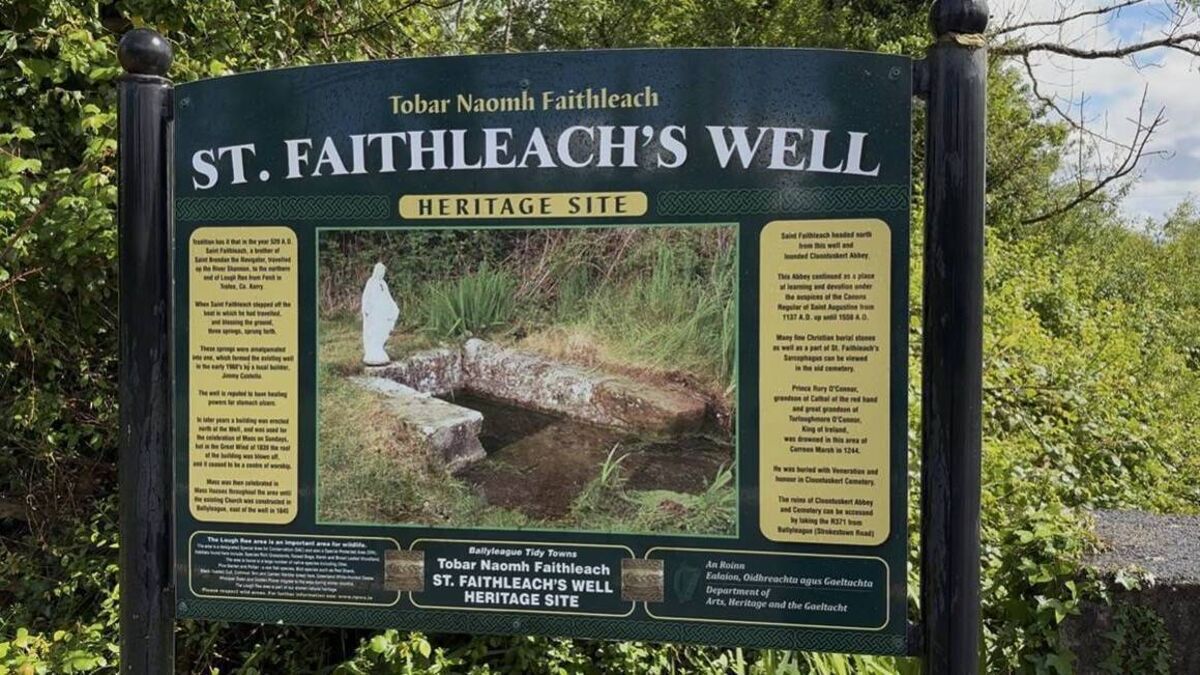
St. Faithleach's Well is associated with curing hay fever.
Just a few hundred yards on the outskirts of Ballyleague a quiet rural landmark continues to draw curious visitors and devoted believers alike.
St. Faithleach’s Well, long associated with curing hay fever, is one of many holy wells across Ireland where folklore, tradition and local identity flow as steadily as the spring water itself.
In rural Ireland, the idea of “the cure” is deeply embedded in community life. For generations, it was commonplace to call to a neighbour renowned for healing burns, sprains or ailments such as tonsillitis. Sometimes, these treatments involved specific rituals or repeated visits; other times, they were as simple as a symbolic gesture. While some still place great faith in these practices, others have seen them gradually fade from everyday life.
Local historian Daniel Curley, manager of Rathcroghan Visitor Centre in Tulsk for over a decade, believes these traditions hold an important place in Ireland’s cultural landscape. With a PhD in archaeology and a lifelong interest in heritage, he has explored both the historical and human stories behind such practices.
He recalls how his own great-grandfather, a seventh son, was said to possess the cure for ringworm. People travelled from counties such as Offaly, Westmeath and Galway to seek help, often paying not with money but with produce or goods from their farms. This exchange reflected not just belief in healing, but a strong sense of community and mutual support.
Mr Curley suggests that while cures may once have been widespread, they have survived more so in rural areas. “I think those cures were there and are there,” he explains. “It’s just that they haven’t survived in modern conversation in those urban areas.” He attributes this to the continuity often found in rural communities, where families remain rooted over generations, allowing traditions to be passed down more consistently.
The origins of these supposed healing properties are not entirely mysterious. According to Mr Curley the benefits of holy wells may partly stem from natural factors. “The curative properties of wells are spring water, and if it’s running across certain minerals in the bedrock, it would have carried a lot of local information—people through time would have felt better,” he explains.
Across the county other wells are also associated with specific ailments. Mr Curley points to St Rowland’s Well near his home in South Roscommon, traditionally linked to eye conditions. “People would have washed their faces with this spring water, and perhaps some of the mineral content within the water could ease certain things,” he says.
Historically, local knowledge played a key role in identifying remedies. Communities became intimately familiar with their landscapes, knowing where to find herbs or natural resources to treat illnesses. “People in the past have been very familiar with certain parts of the landscape where they could get certain herbs that would help regarding certain ailments and certain pains,” he adds.
Today, these traditions are valued not only for their potential remedies but also for what they represent. He emphasises the importance of preserving such folklore as part of Ireland’s cultural heritage. “We have an abundance of local information and local things that we must be very prideful of,” he says, noting that these customs help define the unique character of each community.
He warns that without conscious effort, these traditions could be lost. “These are things that make our little local area. They are unique in their own way and have their own identity and importance,” he says. “We have to maintain them.”
Holy wells, Mr Curley adds, offer a glimpse into how previous generations lived and adapted. “They’re all part of our past. They’re just given as a little hint as to how our ancestors operated and how they survived in tough times.”
For those who visit St Faithleach’s Well today, the appeal may lie somewhere between belief and curiosity. Whether drawn by tradition, heritage or hope for relief from seasonal allergies, visitors are taking part in a practice that stretches back centuries.