Father and daughter honoured with international award
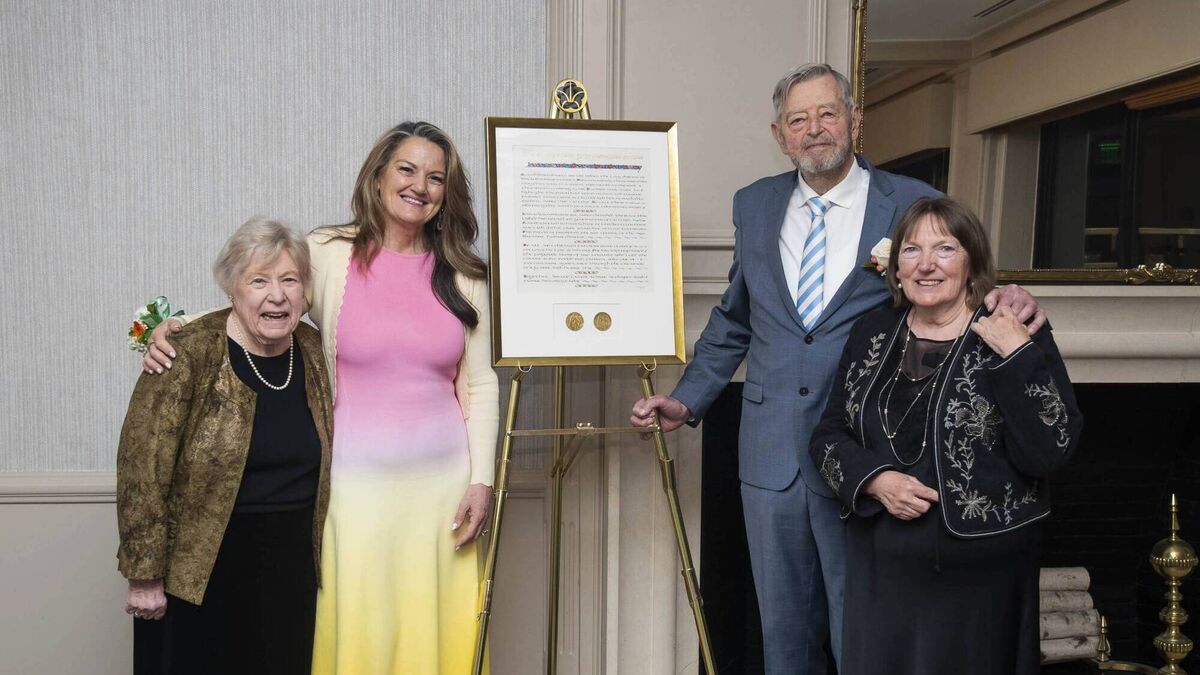
Pictured from left with the framed Éire Society of Boston Award were: Professor Catherine Shannon (Éire Society), Caroilín Callery, Jim Callery, and Professor Christine Kinealy (Director Ireland’s Great Hunger Institute).
Father and daughter Jim and Caroilín Callery, founders of the National Famine Museum and the National Famine Way, have been honoured with the international Éire Society of Boston Award at a ceremony in Boston.
Previous recipients of the gold medal award include luminaries such as Seamus Heaney, John Hume, George Mitchell, Mary Robinson and John F. Kennedy.
The mission of the Éire Society of Boston is to promote the knowledge of Irish culture through the encouragement of study in the arts, sciences, literature, language and the history of Ireland, and to raise awareness of the contributions to civilisation made by the Irish and those of Irish ancestry.
The dedication reads: “Honouring James Callery for his creative leadership and generosity in preserving the lessons and legacy of Ireland’s Great Hunger by founding Ireland’s National Famine Museum Archive in 1994 at Strokestown. Caroilín Callery’s contributions include organising a homecoming for the Canadian descendants of the 1,490 Strokestown tenants who were sent into exile in 1847, launching the biannual Irish Famine Summer Schools, and developing Ireland’s National Famine Way in 2019 and the Global Irish Famine Way in 2022.”
Jim and Caroilin travelled to Boston for the awards dinner, which took place at the historic Omni Parker Hotel where Charles Dickens stayed in the 1800s.
Speaking about the award, Caroilin said: “It was an honour and delight to have this experience with my father - very special. The Éire Society were such amazing hosts with a series of events culminating in the awards dinner.” Jim commented: “The power of the Irish diaspora and their sense of connection and rootedness back to their home country is palpable here. We were shown an amazing time by one and all.”
Two years ago Jim celebrated his 90th birthday by walking the full 165km length of the National Famine Way as a fundraiser for immigration related charities. He raised over €165,000 – a thousand euro for every kilometre walked.
Jim was the person responsible for saving Strokestown Park House for the nation in 1979 and for setting up the National Famine Museum there. Previous honours include a European Heritage Europa Nostra Award (EU Prizes for Cultural Heritage) in 1979 when the citation declared that “The restoration and establishment of the world renowned Irish National Famine Museum & Archive by Mr Callery has been the largest act of private philanthropy for cultural heritage in the history of modern Ireland.”
The National Famine Way crosses six counties and is a collaboration between Waterways Ireland, the Irish Heritage Trust and the county councils along the route. The local authorities involved are Roscommon, Longford, Westmeath, Meath, Kildare, Fingal, and Dublin.
The symbol of the National Famine Way is a pair of children’s shoes displayed at the National Famine Museum. The trail is waymarked by bronze replica shoes as a poignant reminder of the journey the 1,490 evicted tenants made.