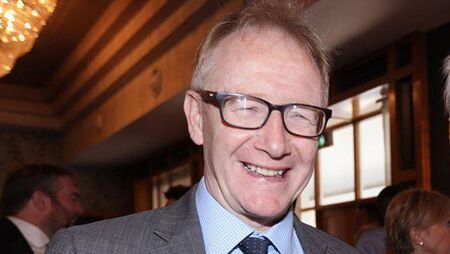
From chronic addiction to sobriety: Donal’s message of hope to others
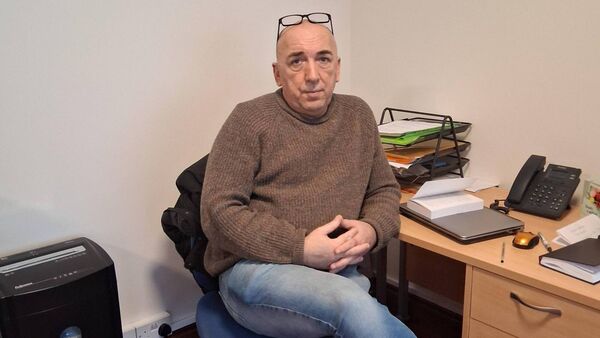
Donal in his office at Hope House in Foxford where he works as an addiction counsellor.
It was Christmas Day in London about 15 years ago. Three young people haunted by their own drug abuse sat around a Christmas table eating a traditional turkey dinner.
As the three desperately tried to recreate some festive spirit, they promised each other to make a fresh start to fight their addiction. Tragically, however, one of them died from a heroin overdose the following year.
One of those sitting at that dinner table was Donal Hanly from Strokestown. Now 52, Donal was in his late thirties at the time. It was his first Christmas working in London and he was in the throes of addiction. The other two people in his company were a couple, both heroin addicts. The young woman who succumbed to drugs was only in her twenties.
While Donal is so thankful that he never touched heroin, that poignant Christmas Day in London is still among the many harrowing vignettes in his story of battling chronic addiction for more than twenty years.
Battling Demons
You can still sense the rawness as Donal talks honestly about the torment of that long battle with his demons. But equally, he is grateful to be a survivor and to be able to share an ultimately uplifting tale of redemption and achievement.
He became addicted to alcohol first, an addiction that can be traced all the way back to when he was a boy who had just discovered a bottle of whiskey in his house.
“I remember my first drink as clear as day. I was about ten or eleven at the time. I took a good slug out of the bottle and I sat down on the couch afterwards. It was like ‘this is it, I have landed’.
“It wasn’t that I wasn’t loved at home, because I was, but taking that drink was like the universe putting its arms around me and feeling everything would be all right,” he recalls.
His progression into addiction from his teen years to young adulthood was rapid but Donal somehow managed to carve out a very successful Gaelic games career. As a talented goalkeeper, he played at U-16 and U-21 grades for Roscommon and won a Connacht medal with the Roscommon junior team.
He was a mainstay between the posts for his own Strokestown club for more than 15 years. He played his first game for the senior team at 16 years of age, winning a senior championship medal in 1992 aged just 19, and won another senior county medal 10 years later.
While his dependency on alcohol continued to be a growing problem, putting on his football boots for his club at every opportunity still gave him important validation.
“No matter what was going on in my life, it really didn’t matter once I was playing. Football was a constant the whole way through a lot of my life. I really loved it and it was the only thing I ever felt part of. ” Sadly, a very bad injury forced him to retire at the age of 32, devastating his ties with the game he had loved since he was a young boy.
Treatment Centre
Off the field, his life was anything but stable, and by the age of 23, he was being treated for alcohol addiction in the Rutland Treatment Centre in Dublin. It was the first of six admissions to rehabilitation centres over the next two decades.
He recounts several memories that reveal the extent of his problem drinking from a very early age. He remembers as a 14-year-old being “frozen to the ground” when he wanted to ask a girl out to dance at a youth disco. He vowed that he would never again go to a disco without having alcohol on him.
Regular blackouts from drink were also recurring themes, often leading to reckless episodes such as having no memory of waking up in a hotel room in Bangkok in Thailand or being carried out of local nightclubs in Roscommon.
His arduous journey to addressing his addiction had multiple setbacks but it did have some temporary successes, including three and a half years of sobriety in his late twenties when he was working in Dublin.
“Things were going really well and I had a good circle of friends in Dublin. I was going to meetings. I was doing all the right things. I was heavily involved in football and in 2002, we won the county final.”’
Unfortunately, he spiralled back into addiction, which led to “the worst 14 years of my life”. It was a period where he became addicted to cocaine and all types of tablets. At the age of 29, he took cocaine for the first time in the toilet of a Dublin pub and became instantly hooked.
Path of Self-Destruction
Looking back now, Donal believes he was on a path of self-destruction as his addiction to alcohol, cocaine and tablets had taken a complete grip of him. His spiral led to a bad car crash, broken patterns of work, financial stress and a period where he found himself homeless only for his parents came to his aid.
During this very darktime, he suffered deep depression and completely isolated himself from the outside world. At one point, he didn’t go outside the door nine months. There were also several suicide attempts. “It was always there in the back of my mind that I could kill myself. There would have been one serious suicide attempt. I took enough stuff on one particular night that I was sure I wouldn’t wake up. The pain was too much.” Added to all of that pain was a crippling sense of shame. “The shame I would have felt was horrendous. That shame just wants you to be on your own and wants you isolated. And I don’t think there’s anybody who’s in addiction who hasn’t felt that huge shame.”
Rock Bottom
By the age of 44, Donal had hit absolute rock bottom. His addictions worsened when he spent seven years working in London, and so too did their impact on his behaviour and his health. “The police cell had become the norm for me. I also ended up in hospital and at one stage I was near liver failure.”
He eventually forced himself to go to yet another treatment centre, this time in St. Pat’s in Dublin. There was little conviction in trying to get clean though; it was more a case of “getting a few people off my back and trying to get a sleep pattern back.” But at one group meeting there with other addicts, there was a breakthrough. He sensed a glimmer of hope. “I got a bit of hope at that meeting because the one thing I heard them talking about was that they had to get honest with themselves. And I remember walking out of that meeting and I thought if I could just stop lying to myself and get honest with myself about everything that I was doing. I did come out of there with hope - it was the first time I had hope in a long time.” Donal quickly threw himself back into rehab meetings which helped him to finally undergo a complete lifestyle change.
“I suppose addiction recovery can be like opening the lid of a jar when the lid is on tight. So I give the jar to you first to loosen the lid. And then we give it to someone else to loosen it and then to somebody else. And then eventually the last person unlocks it.
“When I look back now, that has been the story of my recovery. Everybody I have met along the way has loosened the lid of that jar for me.”
Gratitude
Apart from the professional help he has received on his recovery journey, very high on his gratitude list are his parents, Percy and Maureen Hanly.
He says sadly that at the height of his addiction, “I really broke my parents’ hearts. I can’t even imagine how difficult it was for them.”
Donal also vividly remembers the motivational words of a psychiatrist when he was previously in the Rutland Centre.
“He said to me that the reports he was getting was that I had done very good treatment there. And he was also told by the counsellors that if I ever got my act together that I would actually make a very good addiction counsellor.
“That was a big moment of validation, somebody telling me I could amount to something. And it’s funny, I remember those words again like it was yesterday. His words haunted me but I suppose in another way it spurred me on at the same time.”
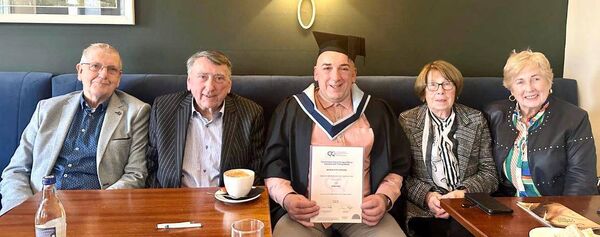
Donal’s initial interest in the area of counselling led him to working in the Vita House Family Centre in Roscommon Town and while there, he completed a psychology course. He then went back to college to study a four-year degree at ICAST, the Irish College of Applied Science and Humanities. In November, he graduated with a degree in Counselling and Psychotherapy with Addiction Studies.
During those studies, he was successful in securing a role as a resettlement coordinator with the Irish Association for Social Inclusion and thoroughly enjoyed the following 16 months working in Castlerea Prison and Loughan House. “I really enjoyed it. And what I saw in Castlerea Prison was that 80% of the people possibly wouldn’t be there only for addiction issues. And the lads I was meeting there were no different to me. You know I’m not condoning anything that they have done but again, a lot of it was caused by addiction.”
Now working as an addiction counsellor at Hope House in Foxford since October 2024, he is involved with a wide range of presenting issues. His particular specialism is addiction while continuing to practise across broader therapeutic areas.
Powerful Story Of Recovery
Donal is keen to share his powerful story of recovery and wants to deliver a message of hope to others, borne out of his own experiences. Because even after all his own relapses and struggles, he emphasises “there is a way out of this”.
“You know, it’s not just about leaving down the drink or the drug or the behaviour. It could be a gambling addiction either. But it does take a complete lifestyle change but it is so worth it. It is so worth it because, for me, even now to walk into my home, I can walk in there with my head held high. There’s no sense of shame and that’s priceless. You can’t put a value on that. It means everything.
“In periods of my life, I had everything materially and I lost them all. But I suppose materially, financially now, I’ve never had less in my life but there’s so much more to lose.
“Even in the years that I was sober, I didn’t work hard enough on my self-esteem; you know, everything was built on quicksand. I have friendships and connections today with people which are hugely important. So I wouldn’t swap what I have today for anything.
“I am clean and sober now for eight years. I feel good and I still have dreams and ambitions. I still have my struggles too but I’m now dealing with them in a different way today.”
If you’ve been affected in any way by this story, you can contact any of the following: Pieta House 1800 247 247; Samaritans 116 123 or Aware 1800 80 48 48. The HSE Drugs and Alcohol Helpline also provides confidential support, information and referrals to services. Call Freephone 1800 459 459 or emailhelpline@hse.ie.