Priests with Roscommon links remembered in unique tapestry
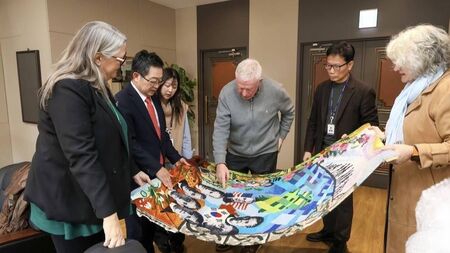
The tapestry features the seven Columban Martyrs, the Korea national flower-Hibiscus Siriacus and a Celtic Cross.
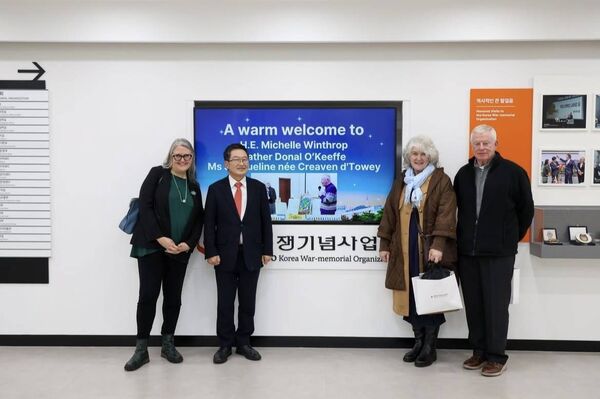
Seven Irish Columban priests who gave their lives during the Korean War, including two with Roscommon links, have been remembered in a unique tapestry recently presented to the people of South Korea in a special ceremony at the War Memorial in Seoul.
The ‘Woven into Memory’ tapestry, which commemorates the 75th anniversary of the deaths of the Korean Columban Martyrs, was designed by Frances Crowe and commissioned by Roscommon Town based Jacqueline née Creaven d’Towey, a relative of one of the martyrs.
The presentation was attended by Irish-Korean ambassador Michelle Winthrop and Fr Donal O’Keefe, a Columban missionary who has served in South Korea for over 40 years.
On December 6th, 1950 Fr Tony Colier, Fr James Maginn, Fr Paddy Reilly, Msgr Patrick Brennan, Fr Tommy Cusack, Fr Jack O’Brien and Fr Frank Canavan all turned down the opportunity to evacuate to safety in the face of the oncoming North Korean forces.
The seven Irish priests, known as the Columban Martyrs, stayed with their flock until the bitter end, and were remembered 75 years to the day of their deaths when Roscommon Town based Jacqueline née Craven d’Towey presented the tapestry to the people of Korea, which will remain on permanent display.
Two of the priests remembered have links to County Roscommon. Fr O’Brien, or ‘The Fighting Padre’ lived in Ballaghaderreen and attended St. Nathy’s College and Headford native Fr Canavan was a paternal relation of Jacqueline’s.

Jacqueline’s interest in Korean history began during the Covid-19 lockdowns when she began watching Korean TV shows. She began noticing strong links between Ireland and Korea and a particular resonation stuck with her following the harrowing Halloween Crush in Seoul, which took the lives of 159 people in 2022.
“Halloween I believe was started in Rathcroghan,” said Jacqueline, “and somehow that incident resonated with me as 159 people of Irish heritage are supposed to have been killed in the Korean War.”
The presentation in the form of a tapestry was also important to Jacqueline. Her paternal grandmother’s family, the Coynes, were lace merchants in Headford, and a Columban nun from Foxford taught weaving techniques to people on the island of Jeju, where a weaving industry was established.
A delegation from the parish of Jeju is set to visit Knock in February and Jacqueline hopes to show them the Foxford Woolen Mills during their trip.
Jacqueline is set to return to Korea for St. Patrick’s weekend, where the tapestry is set to be officially installed on permanent display at the Korean War Museum.
“I’m looking forward to seeing the exhibition, because it’s a huge war memorial. It’s almost like the United Nations. They have a pillar and flags and a beautiful engraved marble plaque, making the different armies and nations that took part.
“Because Ireland didn’t have an official presence in 1950 as an army, we’re not included in that. The plaque for the Irish people, including the seven Irish priests is nearly at the roadsides and I’m beginning to understand the tapestry has been the key to unlocking a permanent exhibition inside the war memorial,” she explained.
She believes that with the support of Cardinal You Heung-Sik and ahead of the Youth Federation Day, set to be held in Korea in 2027, that the seven Irish priests may be canonised.