Roscommon group taking part in Seeking Safety Ireland initiative
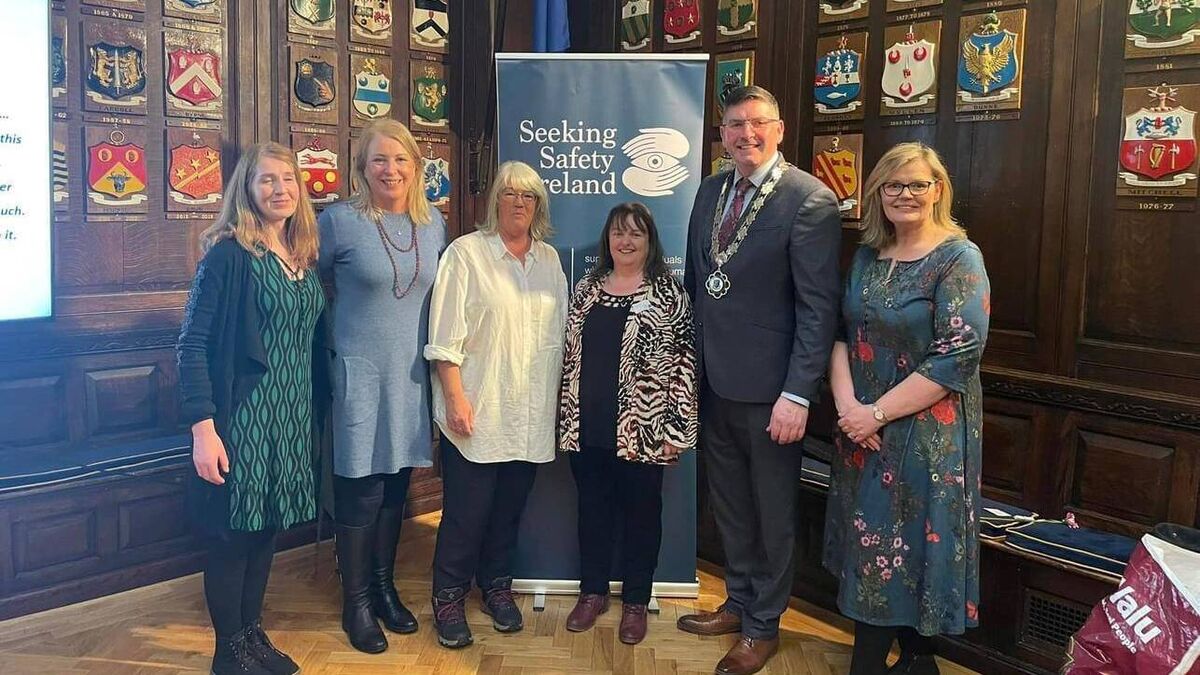
The Cathaoirleach of Roscommon County Council, Cllr John Keogh with representatives of Roscommon Women's Network at the launch of the evaluation of the cross-agency peer-led pilot programme, Seeking Safety Ireland.
Up to 80% of women seeking support for substance use issues report a lifetime history of sexual and or physical assault, according to a new report.
Roscommon is the only rural county taking part in the pilot of Seeking Safety Ireland, under the auspices of Roscommon Women’s Network (RWN). The other five projects are urban based in Dublin and one in Drogheda.
The Lord Mayor of Dublin, Daithí de Róiste, supported by the Cathaoirleach of Roscommon County Council, Cllr John Keogh, launched the evaluation of the cross-agency peer-led pilot programme, which supports women with a dual diagnosis of trauma, because of Domestic Sexual and Gender Based Violence (DSGBV) and addiction. The launch took place in The Mansion House, Dublin. It was attended by Nora Fahy, RWN Manager, Lorraine Campbell and Elaine Brown, Seeking Safety Roscommon project workers.
Finding support for this kind of dual diagnosis up to now has been very challenging for service users explained peer researcher, Megan O’Loughlin. “You can hit a rock bottom … where you have lost everything, your family, your home, your job, your integrity, in the worst way possible. You find yourself in A&E, on the street sick and desperate, in a cell or a psychiatric unit. There I can almost guarantee you will not find a professional mention dual diagnosis and if you were to it would like trying to find Wally in the world’s toughest Where’s Wally Book.”
“We know that rates of DSGBV in Ireland are high by international standards," said the Lord Mayor. “The long-term effects of such trauma often lead to life-long problems with both addiction and mental health. People with this kind of dual diagnosis have had difficulty receiving the right support at the right time. The launch last year of the new Model of Care for Dual Diagnosis by the HSE marks a concerted effort to bridge that gap in services.”
Women who were interviewed for the evaluation by the peer researchers were often unaware of the long-term effects of such trauma, as Joanne (aged 35-39 years) pointed out: “I always thought that PTSD is [just] post-traumatic stress disorder - trauma you had in your past. I never knew that it also leads to addiction. It's a coping mechanism, isn't it? It's a way for you to escape your thoughts. Your feelings. Escape the world, escape the people around you. Escape everything. I never knew any of that until I came here."
A key focus of the Seeking Safety Ireland programme is to allow women to understand the effects of early adverse childhood experiences and DSGBV. It is a peer-led evidence-based coping skills approach to helping people to attain healing from trauma and/or addiction which has been piloted by seven community organisations across Ireland.
“At a time when there is much talk of division in our society, it is reassuring to see so many organisations working together to support women with complex needs,” the Lord Mayor said, referring to that fact that seven community organisations from Dublin, Drogheda and Roscommon all implemented the programme with the support of the HSE and the Department of Health.