Strong Roscommon connections, old and new to New York’s ‘Fighting 69th’
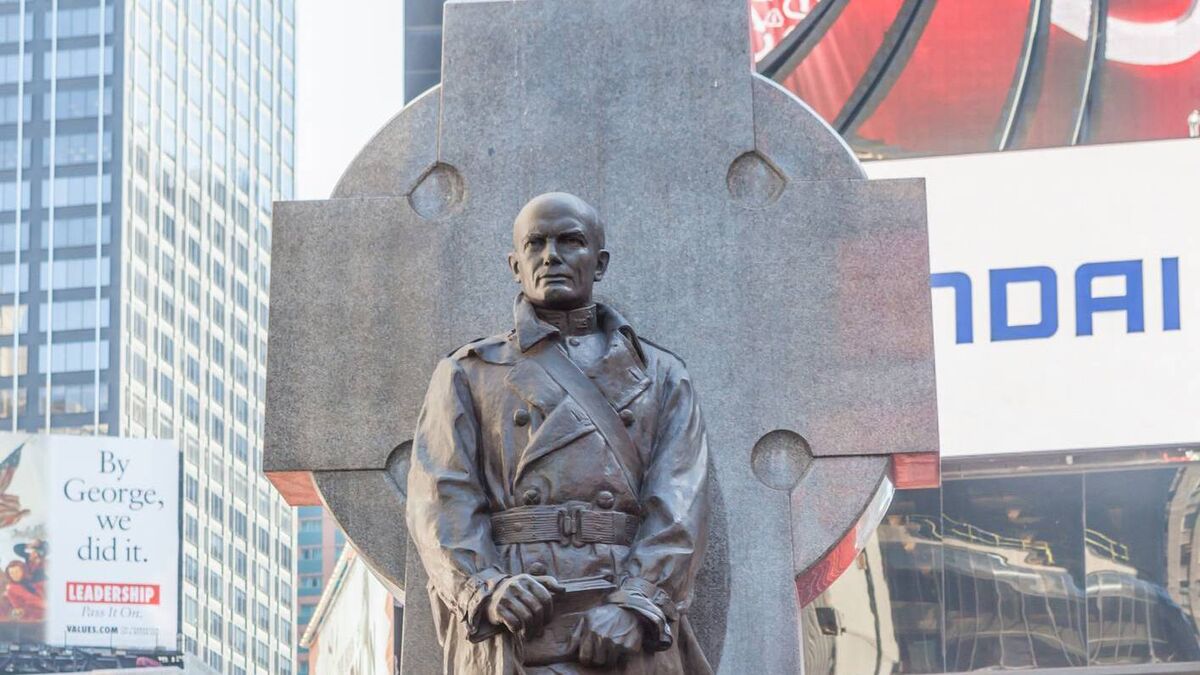
Statue Of Father Francis D. Duffy in Times Square, New York. Pic: iStock
When World Cup fever gripped the USA fans from across the globe gathered at Times Square, New York where one of the famous plaza’s landmarks has a link to County Roscommon.
‘The Big Apple’ hosted eight games in total across the tournament. Prominent in many of the videos, such as Norway’s fans performing a Viking row, was the iconic statue of Fr. Francis Patrick Duffy.
During Roscommon’s trip to New York for the first round of the Connacht Senior Football Championship, many fans from Fr. Duffy’s ancestral home gathered around his statue.
Fr. Duffy was a Catholic priest born in Ontario, Canada in 1871 to Patrick and Mary Ready, his maternal line tracing its roots back to County Roscommon.
Following his service in France during World War I, Fr. Duffy returned to New York as the most decorated chaplain in the history of the United States.
In his early days Fr. Duffy was said to have startled his mother with his precociousness, and would later excel in his studies becoming an instructor at St. Francis Xavier College in Manhattan.
He was ordained in 1896 and eventually earned his Doctorate at Catholic University.
Two years later he volunteered as a chaplain to minister soldiers returning from the Spanish American War, where he contracted Typhoid and was moved back to Dunwoodie, New York to recover.
Back in New York, Fr. Duffy became a popular instructor at Dunwoodie, where his modern views often upset Church hierarchy.
When he was transferred as a parish priest to Our Saviour Church in the Bronx, his progressive mindset was on full display when he suggested the establishment of a daycare centre so mothers could attend Mass.
Alongside his duties as a parish priest, Fr. Duffy served as chaplain for “The Fighting 69th,” the largely Irish-American 69th Regiment of the NY National Guard.
The Fighting 69th were one of the first to mobilise across the Atlantic Ocean following during World War.
In his time stationed in France, Fr. Duffy showed fearless effort in his duties for he wounded and dying in No Man’s Land.
One testimonial recalled the Fr. Duffy broke into tears giving a young soldier his last rites whom he remembered baptising as a baby.
In an unprecedented move for a chaplain, he was considered for the position of commanding officer due to his bravery and patriotism.
However, he ensured that his regiment would be lead back to New York by fellow Irish-American Colonel “Wild Bill” Donovan.
Later Fr. Duffy would ghost write for the first Catholic to run for President of the United States, Al Smith.
As a testament to his regiment and his late friend and famous poet Joyce Kilmer, the priest wrote a book that was later titled Fr. Duffy’s story.
In that book he wrote: “I am a very Irish, very Catholic, very American person, if anybody challenges my convictions. But normally, and let alone, I am just plain human.” Following his passing on June 27th 1932, an estimated 25,000 people gathered for Fr Duffy’s funeral held at St. Parick’s Cathedral. Ten years after his death his statue was unveiled.
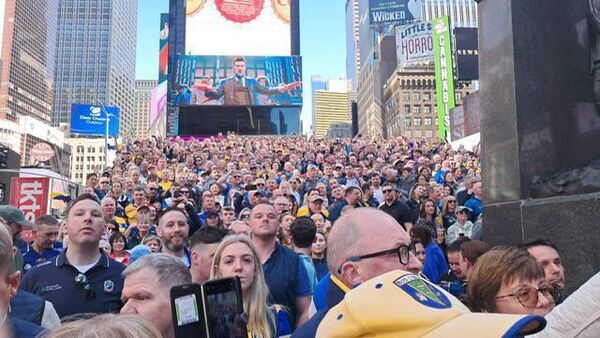
Now, nearly a century on, thousands still gather around his famous statue on Times Square.
County Roscommon’s links with the 69th regiment still remain strong to this day. For many years Boyle native Hilary Beirne has helped to co-ordinate the New York City St. Patrick’s Day Parade, which was led by the Fighting 69th for the 175th year in March.
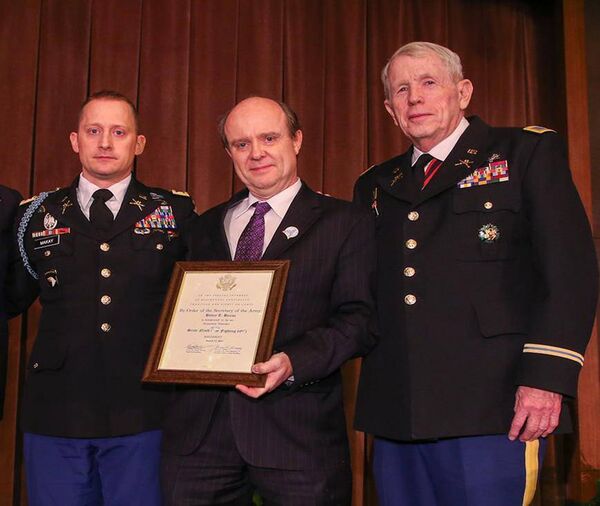
In 2014 he was invited onto the regiment’s staff in a non-active role and was recently appointed as the Irish-US Government relations person.
“The armoury itself is currently undergoing a $140 million renovation and we're hoping to have a grand opening in 2029,” said Mr Beirne.
Mr Beirne shared his wealth of knowledge about the Brigade’s history. It’s founder Michael Corcoran hailed not far from the Roscommon border in Ballymote, and he became a close confidant to Abraham Lincoln.
A direct relative of his, also called Michael, attended school with Mr Beirne in Boyle.
The regiment has also produced some highly influential figures, such as the aforementioned Wild Bill Donovan who founded the Office of Strategic Services a precursor to the CIA.
Mr Beirne said he looks forward to maintaining the strong link between the 69th Regiment and his home country in his new role.