Time for 'Rossies' to discover Slovenia following ‘pairings’ announcement
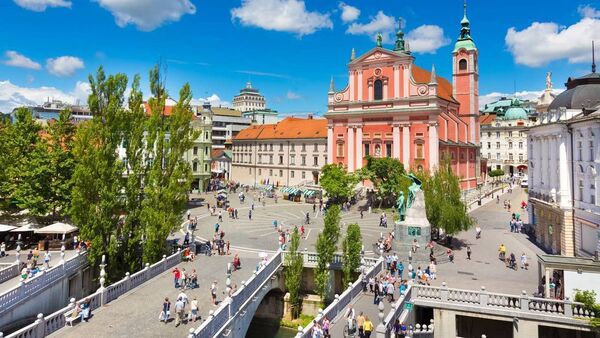
A view of Ljubljana city centre - the Triple Bridge - Tromostovje, Preseren Square and Franciscan Church of the Annunciation, Ljubljana. Pic: iStock
The people of County Roscommon are about to become more familiar with a country nestled in the heart of Central Europe, Slovenia.
The Minister for Foreign Affairs and Trade, Helen McEntee TD, and the Minister of State for European Affairs, Thomas Byrne TD have announced details of an initiative which will engage communities across the country on Ireland’s European relationships during the upcoming Irish EU Presidency.
Each county has been “paired” with a specific Member State of the EU for the period of the presidency and County Roscommon has been paired with Slovenia. Leitrim has been paired with Cyprus, Longford with Hungary, Mayo with The Netherlands, Sligo with Lithuania and Westmeath with Sweden.
During the EU Presidency term, between July and December this year, aAmbassadors of EU Member States in Ireland, accompanied by the Irish Ambassador in the relevant EU Member State capital, will visit counties to undertake a programme of public engagements focused on Ireland’s European relations and its role in the European Union.
In each county, the Ambassadors will participate in a range of public events, including talks at local libraries and visits to schools, as well as engaging with local authorities and local communities through sporting, community, youth and civil society organisations. The visits will help to strengthen links between counties across Ireland and other EU Member States, and will contribute to building Ireland’s relationship with its EU partners as Ireland takes on a significant leadership role at European level.
The programme of visits by Ambassadors will commence in July, following the opening of Ireland’s EU Presidency term.
Population: About 2,108,708 (2025 estimate), with the majority (over 83%) identifying as ethnic Slovenes, along with communities of Serbs, Croats, Bosniaks, Roma, and Hungarians.
Capital: Ljubljana, with roughly 300,000 residents, is Slovenia’s political, cultural, and economic centre.
Primary Language: Slovene is the official language. In border areas—Slovenian Istria (near Italy) and Prekmurje (near Hungary)—Italian and Hungarian also hold co-official status. Slovenia’s literacy rate exceeds 99%, and a majority of Slovenians under 40 speak fluent English, making travel for non-Slovene speakers exceptionally convenient.
With a narrow coastline, it shares its land borders with four countries – Austria, Croatia, Hungary, and Italy. It is mostly a mountainous country.
In 1990, Slovenia established democracy for the first time since World War I. Slovenia had to face the wrath of the Yugoslavian military during its independence from Yugoslavia. The short 10 days war escalated quickly to engulf the whole Balkan region into a war frenzy.