Two special events to highlight County Roscommon pilgrim route
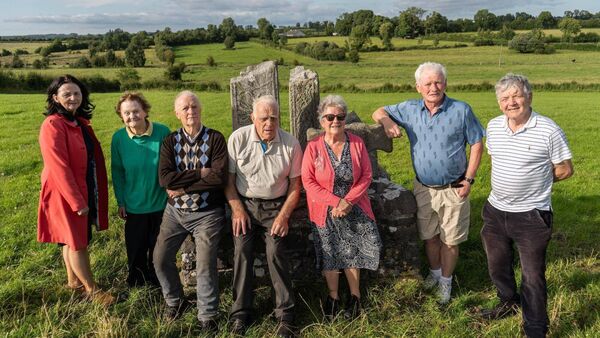
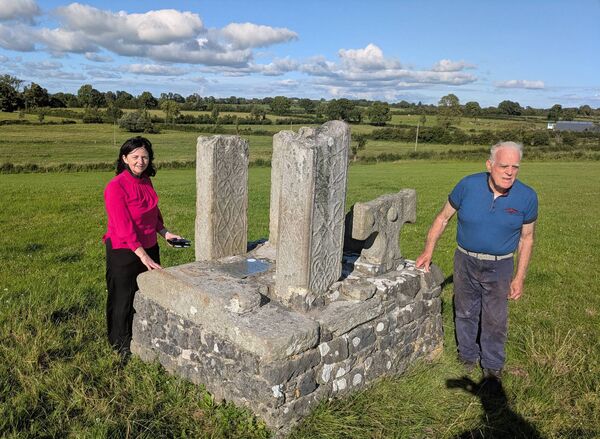
Jacinta Greene Beatty, Lena Connell, John Joe Connell, Seamus Morris, Mary O'Connell, Harry Keegan and Tommy Keegan at Emlagh Cross.
Members of the Castlerea Parish Pastoral Council are set to highlight the Emlagh pilgrim route and its many supporting attributes at two unique events to coincide with the Jubilee Year of Pilgrims of Hope, one of the late Pope Francis’s legacies.
Research academic Dr. Liz Murray of the South East Technological University (SETU) has strong roots in Roscommon as her uncle, Jimmy Murray captained Roscommon to victory in the 1943 and 1944 All-Ireland football finals. She describes pilgrimage in the traditional sense “as a devotional journey to a sacred place, it also offers a way to honour the quiet faith of local people who walked these paths before us. It becomes a living thread of continuity, connecting past and present, land and spirit, memory, and prayer.” To mark the new insights of the Emlagh ecclesiastical site, situated a couple of miles from Castlerea town, Castlerea Parish Priest Fr John McManus, accompanied by Fr. Kevin Reynolds, will celebrate Mass on the Emlagh site at 7 p.m. on Friday, July 25th which coincides with the Feast of St. James, the Patron Saint of pilgrims.
The site is regarded among archaeologists and academics as one of the most important pilgrim sites in the country, featuring an array of historical features and attributes such as the remains of an ancient Celtic High Cross, a ‘Cillin’ which is a type of ancient children’s burial ground and a Holy Well.
The ‘journey’ of discovery of the ancient Emlagh site began last summer when John Joe Connell spoke with his sister-in-law Mary about bringing to public attention the site where an infant family member was interred.
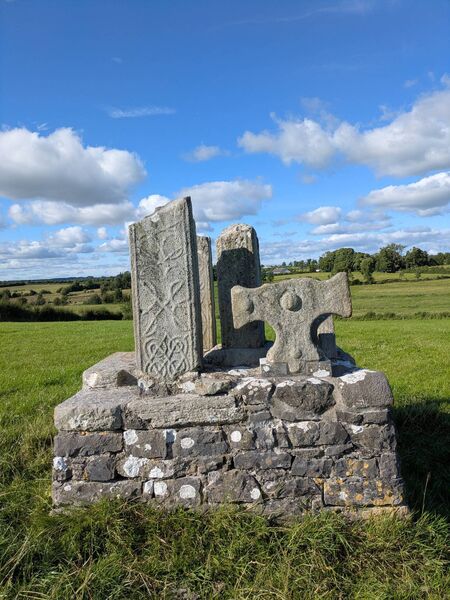
For those attending the special mass on July 25th at 7 p.m. in Emlagh there will be a shuttle bus service running from 5.45 p.m. on that evening, leaving every 15 minutes from Trinity Arts Centre and returning from Emlagh 8.30 p.m..
Parking will be available in Emlagh, but carpooling is encouraged. Light refreshments will be served after Mass by the local community of Emlagh alongside members of the Castlerea branch of the Irish Country Women’s Association (ICA).
This Mass will also see the launch a Dawn Pilgrim Walk or ‘Bóthar Bhrochaid ‘ from Castlerea to Emlagh on Sunday, August 3rd starting from Trinity Arts Centre (F45 AW27) in Castlerea at 6.30 .m. to Emlagh Cross, a distance of 4.2km.
After the walk, pilgrims can return to Castlerea and attend 9 a.m. Mass in St. Patrick’s Church, Castlerea. A shuttle bus will be available for those who do not wish to walk the extended return pilgrim journey.
The pilgrim Mass on July 25th and the pilgrimage on August 3rd will recreate the pattern days of the early Christian period, reconnecting people with their ancestors in a very special and meaningful way at both community events.
The name Emlagh itself comes from the Irish ‘Imleach Each,’ the marsh of the horses or the edge of the marsh of the horses. The link to the marsh is explained by the fact that there was once a lake near the site, which has long since dried up.
The townland of Emlagh is also the birthplace of Bridget Keane, later Keegan, and the mother of Harry Keegan, one of Roscommon’s most decorated footballers, who will be attending the special mass with his brother Tommy at the site of their ancestors.
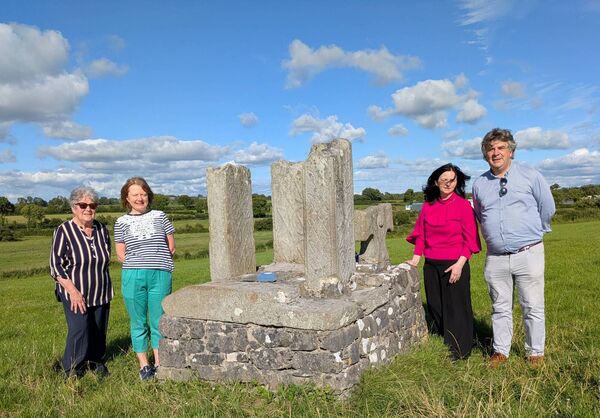
Situated on the southeastern side of Castlerea, off the R377 Castlerea to Ballintubber road, Emlagh Cross is an ancient monument built in approximately 1015 AD at the entrance to the church of St Brochaid.
It has been designated a National Monument in State guardianship, the highest designation possible. Other state care sites in County Roscommon include Rathcroghan Archaeological Complex, Tulsk Abbey and Roscommon Castle. Other sites include Trinity Abbey located at Lough Key in Boyle and a sculptured stone at Castlestrange in Athleague. To place these designations in their proper context, other State care sites include Newgrange in County Meath and Maebh's Cairn on Knochnarea Mountain in County Sligo.
It’s understood the church on the Emlagh site itself was founded by St Patrick between approximately 433 to 434 AD and placed under the administration of St Brochaid, said to be a nephew of St Patrick. St Brochaid’s mother was called Tigris, reputed to be a sister of St Patrick.
The site is located in a field owned by local man, Seamus Morris and has been in the Morris family for generations. There are six large pieces of the cross remaining on the site, despite historical damage.
The church was destroyed and the cross was damaged in the year 1537, as the Reformation intensified in ferocity and Catholic churches and ecclesiastical properties were destroyed throughout the country.
Today the Emlagh site has three notable historical features including St. Brochaid's High Cross, which dates to 1015 when it was made and erected at the entrance to the church. Part of the devotion at the nearby Holy Well was the drinking of the water, and the removal of the water to wash disease affected areas of the body.
Pilgrims visiting the site often left behind a token, such as coins and religious objects. Catholics gave added importance to these Lúnasa Patterns on August 15th and 25th, because of the lack of formal public ceremony as a result of religious wars and the penal laws.
The Holy Well at the bottom of Seamus Morris’s field still contains spring water and supplied people in Emlagh for many years before piped water was installed.
According to Seamus “people have visited the site for generations – we are lucky to have such history of this nature at Emlagh which belongs to the entire community.
“Thes upcoming events will enable our local community to connect and discover the rich history of Emlagh and to honour those infants buried in the Cillín and all those who perished in the church 800 years ago, at this sacred landscape.” The organisers are indebted to Seamus Morris and Joe Mulligan for their generosity and support in facilitating a special Mass and a pilgrimage, which Fr. Kevin Reynolds believes will allow residents the opportunity to experience a true pilgrim experience.
“This pilgrimage promises to be a journey of friendship and fellowship, a spiritual adventure with our ancient Christian sites - our goal and destination. And it’s more , it’s also a journey of faith, a journey within, to an unseen God who is the ground of our being ,our rest in today’s busy and broken world,” said Fr. Reynolds.
The organising committee acknowledge the support of An Garda Síochana, Conradh na Gaeilge, Glór na nGael, Craobh de hÍde, Roscommon County Council, ICA, EU Just Transition Fund, Ireland’s Hidden Heartlands as well as the generous support of local sponsors and local public representatives.
The ongoing historical research will be recorded on the Digital Repository of Ireland ( DRI.ie) through the South East Technological University Waterford for current and future students to access as an important academic resource.
All are welcome to take part in this peaceful and meaningful journey of faith, heritage friendship.
For further information, contact Rita at the Castlerea parish office on 094 9621219 between 10 a.m. and 5 p.m. Monday to Friday or email: castlereaparish@gmail.com.