Fallon's Town Talk: A strange hurling year comes to an appropriate conclusion
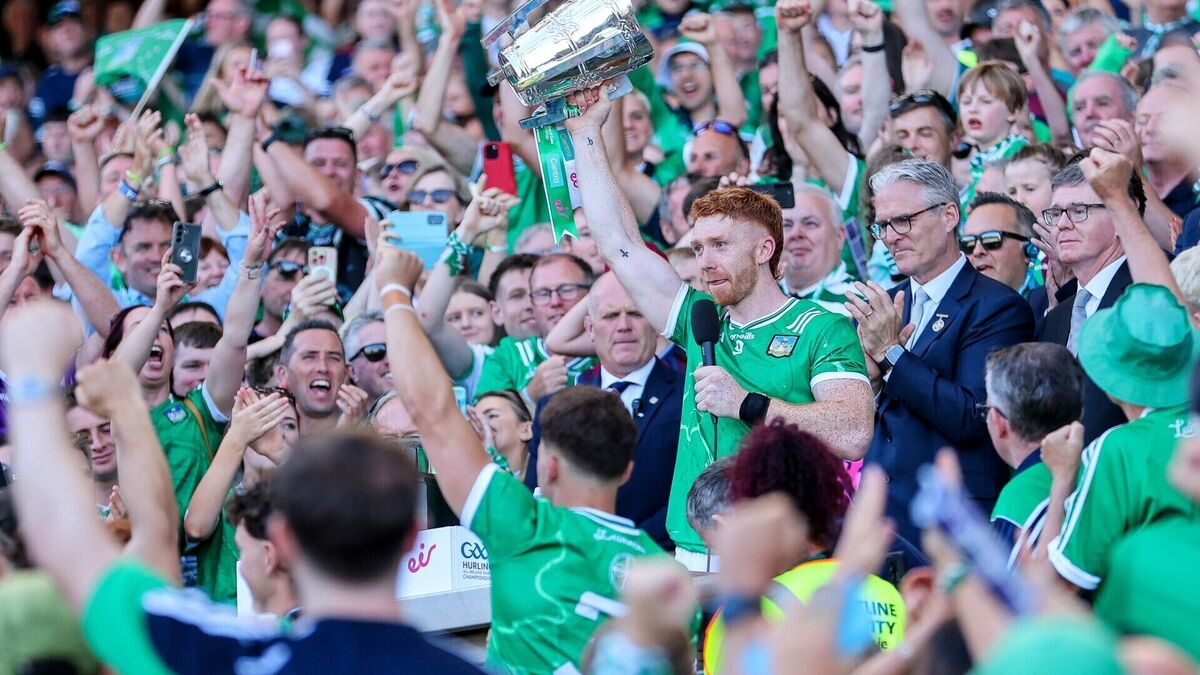
Limerick's Cian Lynch lifts the Liam MacCarthy cup. Pic: INPHO/Ryan Byrne
A weird year for inter-county hurling had an apt denouement on Sunday as Limerick copper fastened their status as one of the greatest teams in history when they overwhelmed Galway in a disappointing, lopsided final.
While the match itself was a flop, the rituals of All-Ireland final day remain special. You don’t have to come from a hurling background to appreciate the words of Eddie Keher, one of the icons of the sport whose father came from Oran, who described hurling as “Ireland’s gift to the world” on BBC television.
On the way to Dublin the brother, the son and I discussed final days past and present. ‘Sunday Miscellany’ on RTÉ Radio 1 had some typically left-field but perfectly-pitched items related to the day. As I’ve written here before, for people who appreciate Gaelic Games, the All-Ireland finals are like Christmas – a time to think about the people you associate with the day- those who gifted to us our love of hurling and football.
The Roscommon contingent was larger than normal, drawn to Croke Park by Galway’s first final appearance since 2018. It was good to meet many familiar faces, including Michael O’Brien, formerly of this parish. As always, the ratcheting excitement building to a crescendo in the half-hour before throw-in is magical – culminating in the parade and the national anthem. Unfortunately, this year’s final was one of those days when the match itself didn’t live up to the preamble.
As Limerick head odd to celebrate, hurling finds itself at a crossroads. For decades, hurling folk have been able to sit back serenely, secure in the knowledge that no matter how average a year the hurling championship has been, it will still be better than its Gaelic Football counterpart.
Now, all is changed, changed utterly. Thanks to the revolutionary work of Jim Gavin and the Football Review Committee, football has been transformed into a thrilling spectacle. It is hard to believe that it’s just two years since football was in crisis after an abject championship and a dire All-Ireland final. The 2024 hurling final was one of the best ever played, the contrast with last Sunday’s cakewalk was stark. Football is no longer just a more popular sport than hurling, this year, and possibly last year as well, it has provided the more compelling championship.
The reaction among the hurling fraternity has mutated from bemusement to concern to an encroaching panic. The consistent brilliance of the Munster championship, which was hurling’s ‘get out of jail’ card, has dipped in the last two years, just as football has undergone its renaissance.
Hurling is under the spotlight; most particularly why, after 140 years, the sport has not grown beyond the same seven or eight counties. Indeed, instead of expanding, fears are growing that traditional powerhouses, Wexford and Waterford, are being cut adrift.
One notable feature of the truncated build-up is how fans consume their preview material. The days when the public would pore over the pen pictures of the players in the newspapers are gone. Podcasts and social media dominate while many of the best newspaper articles I read were online. Legendary former Galway manager Cyril Farrell was a one-man force of nature, popping up on numerous podcasts with his inimitable enthusiasm and repertoire of hilarious stories.
Hurling has struggled for attention in the condensed season but for this, the hurling fraternity deserves little sympathy. It was Galway, Cork and Tipperary who led the charge to crush the proposal to have a two-week break between the men’s All-Ireland finals.
My friend and neighbour, Michael Gilligan, has been in touch. Michael continually undertakes selfless projects to improve the environment and the lives of others. His latest brainwave is among his best.
On Saturday, August 8th in Fairymount Memorial Garden, a Roscommon GAA Wall of Fame will be unveiled. The wall will commemorate every All-Ireland-winning team from Roscommon. Each team, including hurling and ladies football, will be named and pictured.
The wall has a poignant but important added dimension. On the reverse side, players who died while still playing or died at a young age will be remembered. A tree will also be planted on that day. Eight cups, comprising the six provincial inter-county and the two club provincial trophies, will be on display. The dream is, by then, the senior and minor ladies footballers will have emulated the U-16s and three All-Ireland cups will be present.
Knowing Michael, he has put long hours of meticulous work into the Wall of Fame and hopefully the unveiling of this wonderful addition to Roscommon’s sporting lore gets the support it deserves.