Fallon's Town Talk: Reverberations from a tumultuous week will be felt for a long time to come
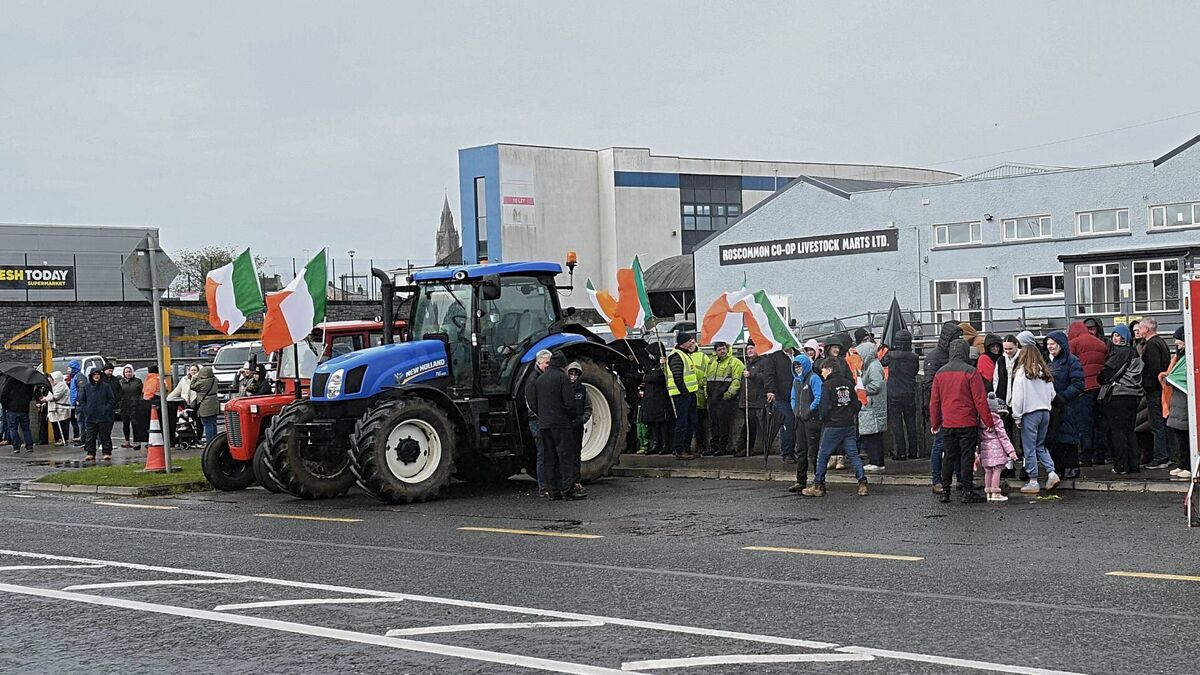
Several hundred people gathered in Roscommon Town on Sunday to protest over escalating fuel prices. Pic: Gerard O'Loughlin
What an extraordinary, tumultuous week it has been. A week from which the reverberations will be felt for a long time to come. It has also been a time of contrasts. In the space of 10 days, four astronauts aboard the Artemis 11 rocket made history, travelling further into space than humans have been before as they voyaged to the Moon and back.
It is a time to be proud of what human ingenuity can achieve. From space, our planet looks a serene, beautiful place. Yet, back on earth, our world feels more divided and dangerous than at any time since a human last set foot on the moon in 1972. Wars rage in Gaza, Ukraine, Sudan and, latterly, Iran.
The attack on Iran by the US and Israel has led to a fuel crisis that last week led to a fracture in Irish society that is among the most divisive in this century, perhaps the most fraught since the water charges controversy.
In Roscommon Town and environs, the level of discontent feels like a throwback to the outrage at the downgrading of services in Roscommon Hospital in 2011. On Sunday, approximately 400 people marched through Roscommon Town to express their annoyance at the spiralling cost of fuel. The agriculture and haulage sectors are suffering and many ordinary people have taken to the streets nationwide to vent their exasperation.
The scenes from Roscommon Town on Sunday bring to mind further contrasts. Last weekend, Roscommon GAA supporters travelled in their thousands to New York for the county senior footballers’ Connacht championship match in Gaelic Park. For me, it brought back pleasant memories of when Gerard O’Loughlin and I went to cover Roscommon’s first trip to the Big Apple in 2006. This is widely expected to be the last time the Rossies play in NY and the fans were determined to make this last dance memorable. The crowds who flocked stateside are on a par, if not larger, than the numbers who went over at the height of the Celtic Tiger in 2006.
Last Saturday throngs gathered in Times Square for a joyous get-together. It was ironic that these happy scenes were taking place in a nation involved in the war that had caused the crisis that is leading to the mutinous mood in Ireland.
However, an ‘Ireland Thinks’ poll conducted last Friday showed that the public don’t blame the war undertaken by the US and Israel for the fuel crisis, certainly not as much as they blame the Irish government. Asked where the blame lies the public said: the government: 46%, the Iran War 28% and the protesters 24%. Overall, 56% of respondents supported the protesters.
That ties in with what I experienced myself on Thursday and Friday. By late Thursday afternoon, panic was setting in as the blockade of ports raised the spectre of forecourts running out of fuel. Queues developed at all the service stations in Roscommon Town. I filled my car at a forecourt – not in the town - where there was a €50 limit.
Listening to people chatting, their fury was directed at the government. On a few occasions I heard the phrase: “This won’t be forgotten.” This coalition got off to a bad start and it has never really recovered. While it is over three years to the next general election, Fianna Fáil and Fine Gael have become the lightning rod for the public’s indignation and it will take something remarkable to turn around their fortunes.
One of the most convincing explanations I heard for the government being out of touch is that neither Fianna Fáil nor Fine Gael has the grassroots membership each had in their heyday. In the past, the foot soldiers would have quickly made public representatives aware of the storm that was brewing. The Easter Recess was another contributory factor to the government being caught unawares.
Two things can be true at once: The protesters have been overwhelmingly dignified and complied with Garda interventions to break up the blockades; they have genuine grievances. Equally, some people have latched onto the protests for their own, less sincere purposes.
As the poll showed, the public were on the protesters’ side last Friday. It’s debatable if that support would have held this week, especially with the return of the school run. The government measures announced on Sunday evening in reaction to the protests, albeit belated, may have averted even greater rancour. Nonetheless, it feels as if this is a lull rather than an end to the acrimonious mood that is prevalent among large sections of the Irish public.