Undimmed consistency the mark of two incredible teams
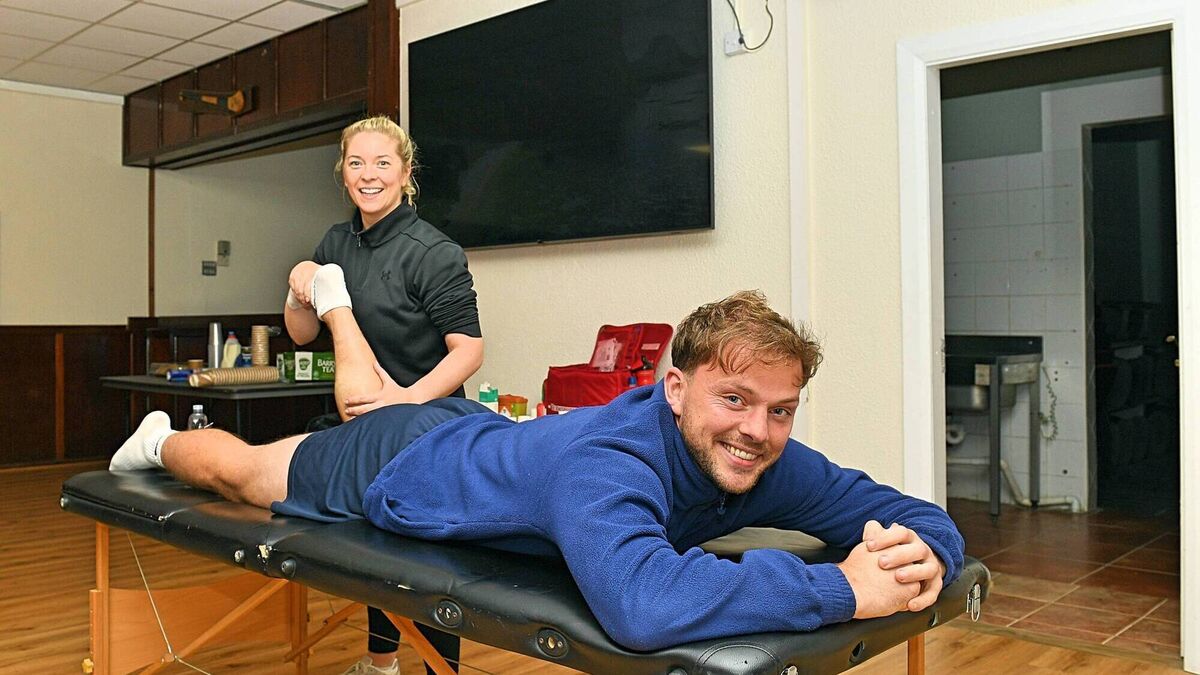
Pádraig Pearses defender Mark Richardson gets some physio from Jenny Downey before training ahead of their side's county senior football championship final against St. Brigid's at King and Moffatt Dr. Hyde Park on Sunday. Picture: Gerard O'Loughlin
When the ball was thrown in for their semi-final clash with Strokestown, injury issues meant that the St. Brigid’s starting team did not include the starting full-back, either of their two county panel midfielders, or their joint captain and playmaker from the side that edged out Pearses in the 2025 county final.
In the Pádraig Pearses versus Boyle game the previous day, Pearses went into battle without their primary ball-winner and Roscommon’s first choice midfielder, without their line-breaking centre forward who found the net in the county final replay, and without arguably the club’s best ever player, who despite being plagued with long-term injuries, was crucial to bending a series of games their way in 2024 and 2025.
And for good measure, both clubs went into the 2026 senior championship with new managers, and greatly overhauled management teams.
These are clubs that are resilient, but this is getting closer to the standard of imperviousness. One of the biggest concerns in the world of medicine is the rising level of antibiotic resistance, but microbial bacteria have nothing on the senior panels of these two South Roscommon powerhouse clubs, whose consistency is undimmed heading into this Sunday’s decider.
It’s standard practice when it comes to analysing games like this to examine each side and identify possible vulnerabilities or areas of weakness, but that doesn’t really apply here.
It’s another testament to the adaptability of the two sides that the aspects of their play that made them so good in 2025 have been less prominent in this championship, while the individuals and attributes that might have been seen as potential soft spots have more than stood up to the scrutiny that they’ve gone through in their five games up to now.
Taking the county champions first, and in 2025, Conor Carroll’s kickout connection with his outfield players was impeccable, and St. Brigid’s retained an overwhelming majority of their own restarts as a result.
During the group games, Carroll happily dinked and dunked the ball out to his defenders when that was offered and St. Brigid’s made hay, but they were attacked a bit more aggressively since then and Strokestown, in particular, got a lot of joy from pushing up, forcing long restarts and competing for the break.
In 2025, Brigid’s were scoring from all over the pitch, with a very wide spread of scoring. Seven or eight players scoring from play was the norm, with three or four out of their starting midfielders and half-backs usually joining in the fun. This year, those numbers have dropped off.
On the other hand, someone looking at their teamsheet would say that they have a lot of smaller forwards and with Senan Kilbride also part of that attacking unit, very much in the latter end of his career, they might be vulnerable to short kickouts, or find it difficult to pull off a full on high press. But that hasn’t materialised.
Ruairi Smith and Michael Sugrue started in the full-back line last time out and with their relative lack of experience, they would also have been obvious candidates to be targeted.
Smith was withdrawn early in a move to find a more natural match for Seán McDonnell but, in general, he has been one of their leading lights this year. Michael Sugrue quietly worked his way into the game and by the end, looked right at home. Meanwhile as a collective, they move like a colony of ants, always with the perfect shape as a defensive unit, instead of leaning on watertight marking from individuals.
Here too, in the matter of previous strengths no longer acting as cornerstones while perceived weaknesses have become strengths, there are parallels with the lie of the land with Pearses.
Gone is the watertight defence that leans heavily on physicality and coughs up very few chances, but they’ve seamlessly transitioned instead into a “bend, but don’t break” defensive system that concedes very few frees, and relies on forcing opponents to take tough shots from open play and let the chips fall where they may from there.
In 2025, Pearses were one of the most prolific teams from outside the arc, with Conor Ryan, Declan Kenny, Paul Carey and others contributing freely in terms of two-point shooting.
This year, that has flipped around and while Declan Kenny’s sensational double at the end of normal time against Boyle proved that they have that in the locker, instead Pearses are leaning heavily towards accuracy and high percentage shots, with just three wides across the last two games, in which they scored 8-39.
The linebreaking that we saw so much of from Kenny, Jack Tumulty, Seán Canning, Eoin Colleran and others is far less common, but in its place there is some very astute off the ball running lines and creation of space, with Paul Carey leading the way, playing a key role in three second-half points for Pearses last time out, despite not putting his name on any of them.
And in Pearses too, less-heralded players have stepped up to become key men. Jack Nevin has been a difference maker all year long, freeing up Declan Kenny to deputise for Ryan at midfield, and while last year it was quite common for either 14 or 15 of the starting team to still be on the field until victory was all but assured, this time we’ve seen Pearses use the bench much more meaningfully, as evidenced by Adam McGreal’s heroics last time out, or the clever use of Hubert Darcy and John Price’s all too brief but dazzling cameo against Michael Glaveys.
Whether the new management teams on both sides deserve a world of credit for seamlessly guiding their panels through these transitions and coming out the other side as good as ever, or whether the panels themselves have just become so autonomous that they organically understand how to evolve and respond to setbacks in a seamless fashion, is impossible to tell.
Either way, expect a game of phases on Sunday afternoon in King and Moffatt Dr. Hyde Park. No doubt in the early stages, St. Brigid’s will look to replicate the joy that Boyle got from attacking Pádraig Pearses from deep positions, with Oisín Cregg and Tadhg McKenna particularly prominent in that game.
Likewise, Pearses will study, in-depth, what Colm Neary and Colin Compton did so effectively to control the breaking ball battle around the middle, while Keelan Beirne seemed particularly effective at reading Conor Carroll’s restarts before they left the boot of the Roscommon goalkeeper.
But after that, there will be another phase, and another, as these teams respond to what’s unfolding. The day of increasing the levels of fire and passion getting prescribed for every ailment is dying out in the GAA, but those times are long extinct around Kiltoom and Woodmount. Composure and cold-hearted analysis is all that you’ll get from these management teams, because it is the language that these players speak.
It’s a lazy cliché, but in a game that’s sure to swing over and back, it’s very difficult to imagine either team establishing a commanding lead before the closing minutes, and it’s incredibly easy to visualise the stadium clock ticking past the hour mark with one score (or less) separating the teams.
The two teams will cause each other problems, they will each find ways to address those problems on the fly, and they each have impact players coming off the bench to aid in that process.
And on the basis that a level score after an hour is as likely as it has ever been, and that one side out of the two have made a habit of plunging themselves into an extra-time shootout and coming out alive, if there is a 51/49 edge one way or another, it might just lie with the club trying to win back the JJ Fahey Cup, as opposed to the one trying to retain it.
But for football supporters, chess afficionados, and sports psychologists and tacticians alike, watching these two incredible intuitive and adaptive sides plot and manoeuvre their way through the hour will make for fascinating, wonderful viewing.