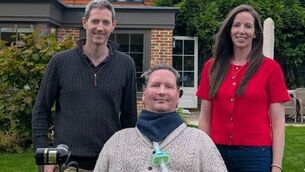
Roscommon man helps pioneer thought-controlled wheelchair after brain implant
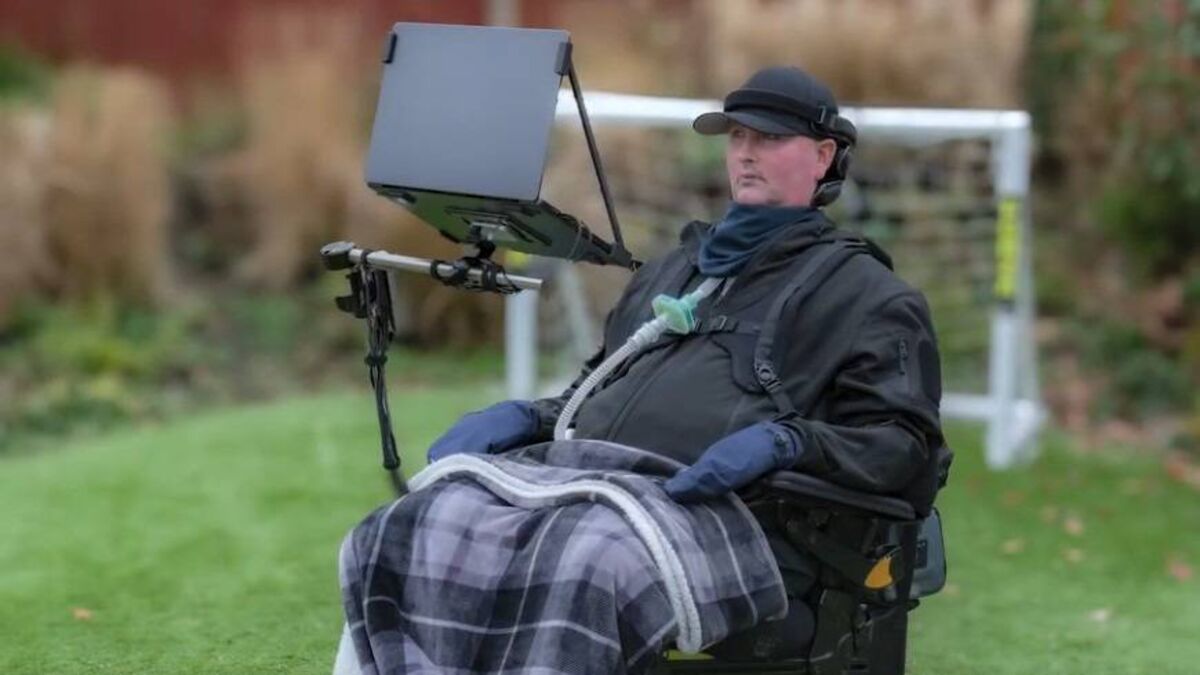
Cutting technology allows Eoin operate his wheelchair by his thoughts.
For over ten years before a life altering day in June 2020, Eoin Egan enjoyed a hugely successful London career in architecture, property consultancy and high-end project management.
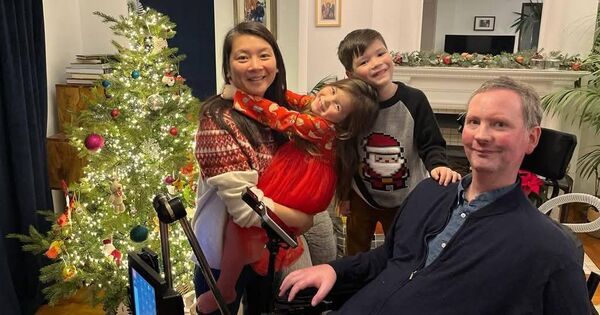
The devastation sank in immediately. “I was thinking how am I going to manage my wife through this? And the kids? Liam was two and a half and Roisin was only nine months old. I guess our true greatness is how we respond in times of great adversity. My sole focus became preparing and seting up my family for a future without me,” Eoin recalled.
Support from home came quickly and powerfully. “My aunt arranged a Mass for me at home in Ireland. During a weekday in a rural church in South Roscommon, a large congregation of family and friends came together to pray for me. The priest, a family friend, spoke to me through the camera as I sat alone in my living room in London looking at the laptop screen while bearing the enormous weight of a terminal diagnosis,” he added.
Further heartbreak followed in 2022 when his father passed away from cancer and because of his own deteriorating condition, he could only watch the funeral service remotely from his London home.
As his MND worsened, Eoin lost the ability to move and speak, eventually becoming fully paralysed and reliant on a wheelchair.
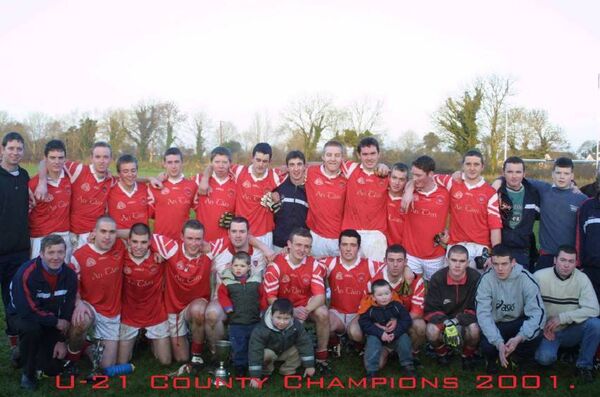
Throughout our conversation, Eoin frequently returns to one of the big passions in his life – his love of Gaelic football. A dedicated player in his younger years with Pádraig Pearses, Garbally College, UCD and in London, he believes sport has shaped his mindset.
“I do think the toughness of things like GAA helps build that resilience. I remember one of the posh English bosses telling me in a meeting that this is not a Gaelic football match when he thought I was going too hard on the other side. I took that as a compliment!,” he said.
That same mental toughness now underpins his approach to living with MND - and to embracing revolutionary technology.
Before his brain implant, Eoin first relied on other advanced technology, two eye-tracking systems to communicate through his laptop and drive his wheelchair, namely specialised glasses and a mounted communication device.
“I had two methods of driving my wheelchair using eye movement - the eye tracking glasses, my ECC Pupil, which didn’t allow me to communicate when worn and were unreliable to be honest, and secondly my eye tracking communication device which is like a computer tablet with a camera mounted in front of me that tracks eye movement but is hyper sensitive to sunlight,” he explained. These limitations restricted his mobility and time outdoors.
Away from the eye tracking technology, his focus soon started shifting to more advanced frontiers – Brain-Computer Interface (BCI) technology, a development pioneered by a number of companies but most prominently, Elon Musk’s Neuralink company. A BCI, implanted in the brain, allows users to communicate directly with external devices such as computers - bypassing nerves and muscles entirely. His opportunity to trial the implanted chip came in early November 2025 when his wife spotted a Facebook post about a Neuralink clinical trial.
“I immediately filled out an online application form and they came back to me quite quickly and I had some video calls with their engineers in California. I attended Queen Square Hospital in London for assessments and scans before undergoing the surgery.
“I had to sign many disclaimers, as you would expect, with a clinical trial and there was no commitment or certainty that it would work so it was very much a leap of faith,” he said.
In December last year, he underwent the brain chip surgery. “The implant was installed within about six weeks of my wife forwarding the Facebook post to me. The operation took six hours and was performed by a robot. I became the 20th person in the world to receive an implant but there could be thousands more in the next few years,” he noted.“I was discharged after two days, and the day after I got home, we connected the BCI to my laptop via Bluetooth. After a short calibration, it worked perfectly first time.”

The BCI comprises 125 threads with eight electrodes on each thread, picking up electrical signals from his brain. These signals are translated into intended movements. The implant, as calibrated for Eoin, allows him to move a cursor on a screen keyboard on his laptop by imagining movement in his paralysed left wrist, and to operate click commands by visualising specific finger movements. This incredible innovation allows him to use his laptop for communicating with his family and friends, and for work purposes.
He continues to operate his commercial property investment business. “I can do everything via email,” he said.
The words he types on the screen keyboard can also be converted into his “original Roscommon accent” which he previously banked.
“I banked my voice soon after diagnosis as I was advised to do so. Last autumn a new artificial intelligence technology became available that could be used to generate a new voice clone from a small sample of my voice,” he said. “It is indistinguishable from my original voice that I lost.” Being able to communicate using his original voice means everything to him and his family.
Even before receiving the brain implant, however, he had set himself another major goal - to drive his wheelchair using thought alone.
With the help of his wife Jenny, an optometrist, and his sister Ethel, a bioengineer, they created a crude home setup by linking eye-tracking software with the brain implant system. By doing this, they effectively tricked the eye-tracking system into responding to his thoughts instead of eye movement.
He tested the setup just four days after surgery. “It worked and we believe that may have been the first time anyone has driven a wheelchair using thought alone,” said Eoin.
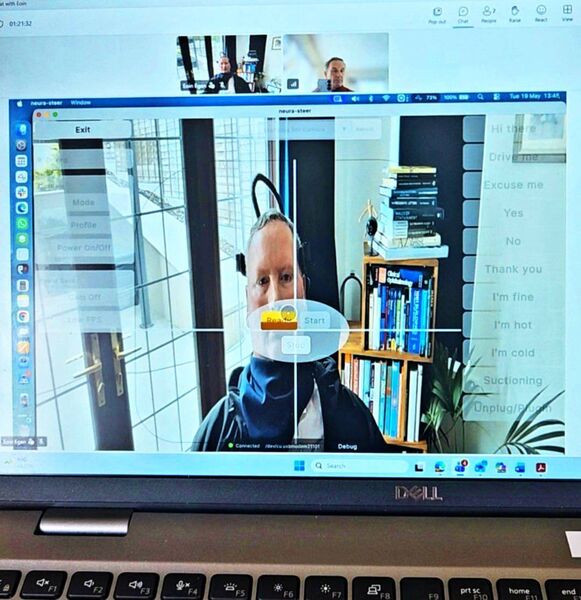
German assistive technology company Homebrace, which had previously provided him with eye-tracking glasses free of charge in return for his help marketing them in the UK, quickly came on board to develop his thought-controlled wheelchair concept.
“Without my suggestion, Homebrace came back to me and said they wanted to build a bespoke software just for me to work directly with my BCI laptop. They already had eye tracking software which they modified for BCI,” he explained.
The new system uses a laptop screen mounted to his wheelchair, allowing him to control movement with his thoughts by using the bespoke software. “I can control the cursor with the BCI in my brain. I can start driving by hovering the cursor over the ‘ready’ setting and then the ‘start button’ at the centre of the screen. I then see an arrow which is telling the wheelchair which way to move. The lowest speed is useful for indoors or tight spaces, and the highest speed is useful for outdoors on wide open footpaths.
“I have precise control of the wheelchair with my thoughts which enables me to drive through tight spaces and around obstacles,” he outlined.
Needless to say, the ability to use his wheelchair on his own has transformed his life.
“At home our curtains are now open as I am not relying on eye tracking to communicate which is disabled by sunlight. I can go outside and not only drive my wheelchair independently but communicate all the time.
“As the weather improved, we have started to have many family days out and I only need one carer during the day to help with my respiratory care. I have driven to my son’s school to watch his games which he loves. He is also training with the local Gaelic football team here in London. My wife and children all watched the Connacht final at home on the TV and the children were ecstatic with the result as was I.
“But what I most enjoy is being able to go for a walk with my wife and children again. I can enjoy precious time with my loved ones and be actively involved in family adventures. It’s given me back a sense of independence I thought I had lost. I am so grateful to the team at Homebrace for making it possible,” he said.
During this incredible journey, he remains deeply appreciative of the support from his wife, children, siblings Ethel and Emmett, who are also London-based, his friends and his mother Geraldine who has made regular flights over from Falty to see all her grandchildren.
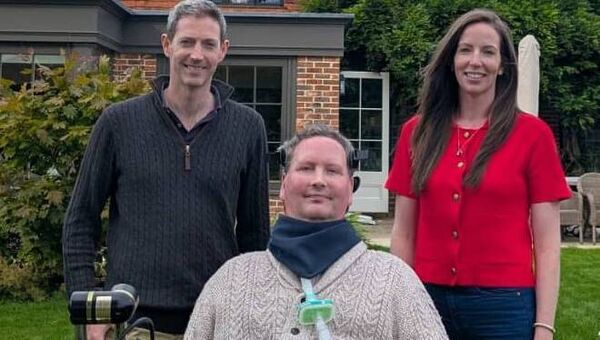
Although still in its early stages, the thought-controlled wheelchair concept is now being presented at conferences.
“My neurosurgeon showed a video of me driving around the park at a conference and my wheelchair technician will present at another. I’m giving a presentation myself at another conference next month,” he remarked.
With BCI, the horizons are vast and he is already looking to the future for further benefits from this cutting-edge innovation.
“What you’re seeing here is part of that journey. It’s still early days but moments like these show what might become possible and I’m excited to see where this goes next.
“My implant can pick up vast amounts of imagined movement and I am only using a few small, imagined movements to control a computer mouse at the moment. So the possibilities are endless. It’s a pipe dream right now but if I could have an exoskeleton that’s controlled by the brain implant - I could walk again.
“Technically it is possible I believe,” he said.
Today, Eoin can communicate, work and control his wheelchair using thought alone.
Still, what matters most to him is spending quality time with his family.
“Being able to move through my environment again, spend time in my garden, and go for walks with my family means more to me than I can put into words.”
*During the online interview with Eoin, he communicated through the chat function on the Teams App.