Strokestown woman details her battle with Lyme disease
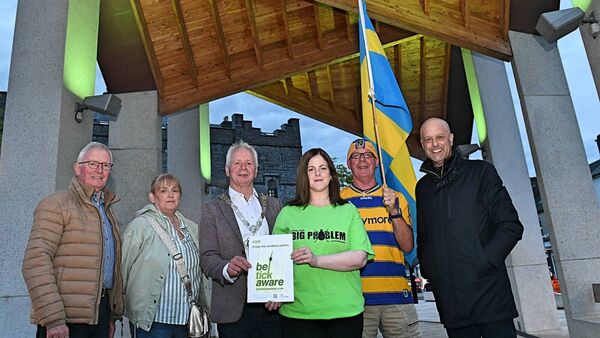
John, and Patricia O’Beirne, Cllr Liam Callaghan, Cathaoirleach Roscommon County Council, Jennifer O’Beirne, Paddy Joe Burke and Deputy Martin Daly at the lighting up of the civic space in Roscommon Town on Saturday night May 23rd by Roscommon County Council as part of the ‘Light Up For Lyme' awareness campaign. Pic: Gerard O'Loughlin
Life had been going great for Jennifer O’Beirne from Strokestown – she was studying for her final exams in Trinity, had great friends and family, and was enjoying life as she looked forward to embarking on her chosen career. However, all that was to suddenly come crashing down around her and her life began to crumble as Lyme disease gradually began to take over her body. It would take Jennifer over ten yeas to get an actual diagnosis but with no cure, her life today is one of physical pain and cognitive fog as if her brain “is on fire.”
Lyme disease is a bacterial infection spread by the bite of an infected tick. It is considered the fastest growing vector-borne disease in Northern Europe and with global warming tick populations are increasing. They can be as small as a speck of dust but once they infect a person the results can be devastating.
Jennifer could not image the battle she had in front of her after those first few symptoms developed when in her final year at Trinity College. “I am 39 now and I've probably been sick since my 20s, but I didn't get answers until my early 30s. I don’t remember getting a tick bite but they think I probably was infected in childhood or earlier in life and it just took until my 20s for it to kind of overpower my immune system and eventually came out as a chronic illness and bit by bit over the years the symptoms built up.” She recalled: “I was in college getting ready for our final exams and I suddenly couldn't function. I couldn't study, I couldn't put my thoughts into words while I was studying, and I couldn't translate my thoughts onto a page. I couldn't explain it or put it into words to anyone, I couldn't tell them there was a problem.
“Sometimes I would leave to get from A to B, but it might take 10 minutes, or it could take an hour, I think it was like dementia or something like that. I suppose someone realised there was something going on and I was unwell. I was told it must be depression, burn out, I must be stressed or I must hate my course. I was being told it was all in my head which apparently, is very common (when trying to get a diagnosis).” Due to her ill health she returned home to Strokestown. In her mid-20s she began to feel the acute effects of the illness, with the neurological and cognitive symptoms starting but even at this point no one seemed to be able to tell her what she was actually suffering from.
“The physical symptoms started with a lot of neck pain, a stiff neck, swollen glands, like the worst sore throat that never went away.
“The doctors started sending me to consultants and that started about six or seven years of going to consultants and having no answers and nobody really believing me, at every turn I was kind of dismissed and doubted and questioned as to whether all my symptoms were really there. I was told I was just stressed, I just needed to do yoga, to look at my diet, and all the normal gaslighting.” She underwent a battery of tests seeing specialist after specialist and was even tested for Lyme disease, but all the results came back negative. However, she said that in hindsight this is not surprising as “I know it (the Lyme disease test) can give false negatives because the tests are at best 50% accurate. There's no perfect test in the world for it at the moment.” She was prescribed numerous courses of antibiotics but recalled: “I tried everything and nothing was working; it was getting worse and that went on for months and months. Eventually my whole body was sore, it was everywhere, in my arms so they were burning, it was like my whole body was on fire.
Then a light appeared at the end of the tunnel. “Someone told my dad that they heard someone speak about [Lyme disease] awareness month and about their partner’s story, outlining the symptoms they lived with and how it impacted their life financially and medically. Some of the symptoms sounded like what I was experiencing.” Asa result of this she got in touch with Professor Jack Lambert, a consultant in infectious diseases in Dublin.
She found out about some German tests and had her blood work sent off for more specialised Lyme disease and tick borne infection testing.
She said even though no one want to get a diagnosis of Lyme disease “it was a validation for me” after all the years she had spent suffering. She finally felt that someone believed her.
At the moment her illness affects her whole body. “I have a lot of intense spine pain and pains in my muscles and joints and nerves similar to a bad flu. It’s like if you're dealing with the worst flu, you've ever had but you still have to get up and move around. I have migraine type symptoms, I get vestibular migraines resulting in dizziness which affects balance with motion, light and sound triggering it. The infection can infiltrate your brain so it's like your brain is on fire - that's the constant kind of thing.” She now likes to volunteer her time with some of the awareness organisations, most of which are made up of patients and families. They feel there is a lack of public awareness and want to give people the information and tools to stop them suffering as she has.
“Awareness is the best prevention,” she added, and part of that was the lighting up of the civic space in Roscommon Town on Saturday night by Roscommon County Council as part of the ‘Light Up for Lyme' awareness campaign.
Jennifer is also hoping that the council might consider providing signage in public areas warning of ticks, what to do if bitten and links to organisations that can help.
Ticks are found in all counties in the country but are more prevalent in the West of Ireland and along with climate change the population of the insects is expected to increase.
“Healing is never a straight line, especially with something like this so I suppose I have the hope, the positivity and the resilience that there is a way forward and that it will improve. I just have to keep working on the treatment plan as with any serious condition and just hope my body will heal in some way.” More information on the disease, symptoms and supports is available at www.ticktalkireland.org or www.lymeresourcecentre.com You can learn how to protect yourself and your family, how to prevent tick bites, and what to do if you get bitten at: https://youtu.be/26IZmBQjS8o?si=9Slc19LsOdcrUEr