Herald Opinion: Home is not just about geography, it’s identity
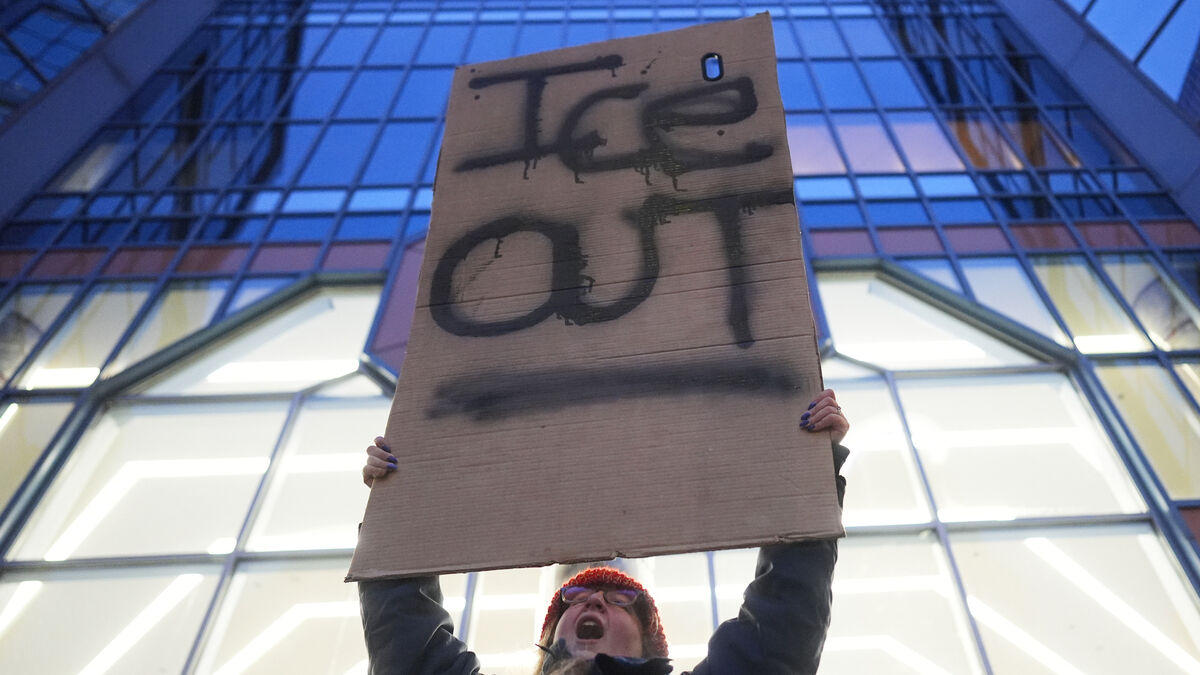
A demonstrator holds a sign reading "ICE OUT" during a protest in Minneapolis. Pic: AP Photo/Adam Gray)
It’s Saturday night, February 14th, and I’m in the process of writing my column, sadly my computer is giving me bother, battery flat, refusing to take a charge looking at a dark screen, I’m anxious. Outside, snow rests on the ground. A sharp February cold. But Valentine’s Day 2026 wasn’t about cards or candles. It was about memory.
Thirty years have passed since our father died in 1996, just seven months after retiring from An Garda Siochana. Retirement should have been the gentle chapter; time earned after decades of service. Instead, it became a brief coda. A lifetime ago, and yet not.
So, on Saturday we gathered in Loughglynn. Our mother, her five sons, wives, children. Kieran the youngest and his family home from New Jersey. The house full in the best possible way. The cousins mixing effortlessly, as children do, unconcerned with time or distance.
While they mixed, the adults talked. That’s the natural order of things. And when three brothers work for American multinationals and another is based in New Jersey, conversation will inevitably drift westward. Politics crossed the Atlantic before dessert was finished.
The youngest brother is secure on paper, has a green card, American wife, established life. But security feels different now.
For decades, there was a quiet understanding. The undocumented Irish in Yonkers on McLean Avenue, in South Boston, in Chicago, worked hard, paid their taxes, kept their heads down. They built lives in the place that calls itself the land of the free, free in almost every respect except the ability to board a plane home without fear.
For decades there was an assumption that being Irish and white offered insulation. That hard work softened illegality into technicality. That assumption no longer feels secure.
President Trump’s renewed focus on immigration enforcement leaves little room for nuance. Illegal is illegal. The rhetoric is blunt. “Spongers,” he calls them. It makes no distinction between the idle and the industrious, between criminality and paperwork expired.
And so the unease grows.
What must it feel like to be trapped like that? To miss funerals. Weddings. The small, ordinary visits home that sustain emigrants. To watch snow fall in Ireland on a screen and know you cannot risk returning to walk in it. Home is not just geography; it’s memory, belonging, identity.
Ireland likes to think it holds influence in America. We point to Capitol Hill and to the long list of Irish surnames in public life, Kennedy, O Neill, Donnelly the list is long. We recall a time when being Irish in Washington carried weight. But influence ebbs. Administrations change. Diplomats rotate every four years, sometimes just as relationships begin to deepen. Diplomacy is built on familiarity and longevity. Contacts matter.
Will Micheál raise the question of Irish detainees when he meets Trump? Can a case be made for leniency. Or is that expectation itself revealing?
Perhaps we tell ourselves we deserve special treatment because we were there from the beginning — famine ships and tenements, railroads and police forces, unions and city halls. The United States is a nation of immigrants, and the Irish helped shape it. We remind ourselves of that history often.
But history does not automatically confer exemption.
There is a certain irony in discussing deportation over tea in Loughglynn, snow outside, while remembering a man who served the Irish state faithfully for decades. My father’s generation saw emigration as necessity. America was opportunity. Now Ireland is wealthier, multinational companies based here, brothers employed by American giants without ever leaving home.
The direction of movement has shifted. The uncertainty has not.
In the end, though, the day was about something steadier than policy. It was about continuity. Your mother surrounded by her sons. Grandchildren running around the same garden. Stories revisited. Laughter layered over loss.
Machines fail. Governments change. Immigration rules tighten and loosen with elections. The global conversation grows louder and more complicated.
But a family gathering in Loughglynn on a cold February evening remains wonderfully simple.
And perhaps that is the quiet truth beneath it all: whatever happens in Washington or Texas, whatever ICE decides or presidents declare, the most enduring ties are the ones that bring five brothers home to mark a father’s memory.
No charger required.