Herald Opinion: A moment of real change has arrived for Ireland
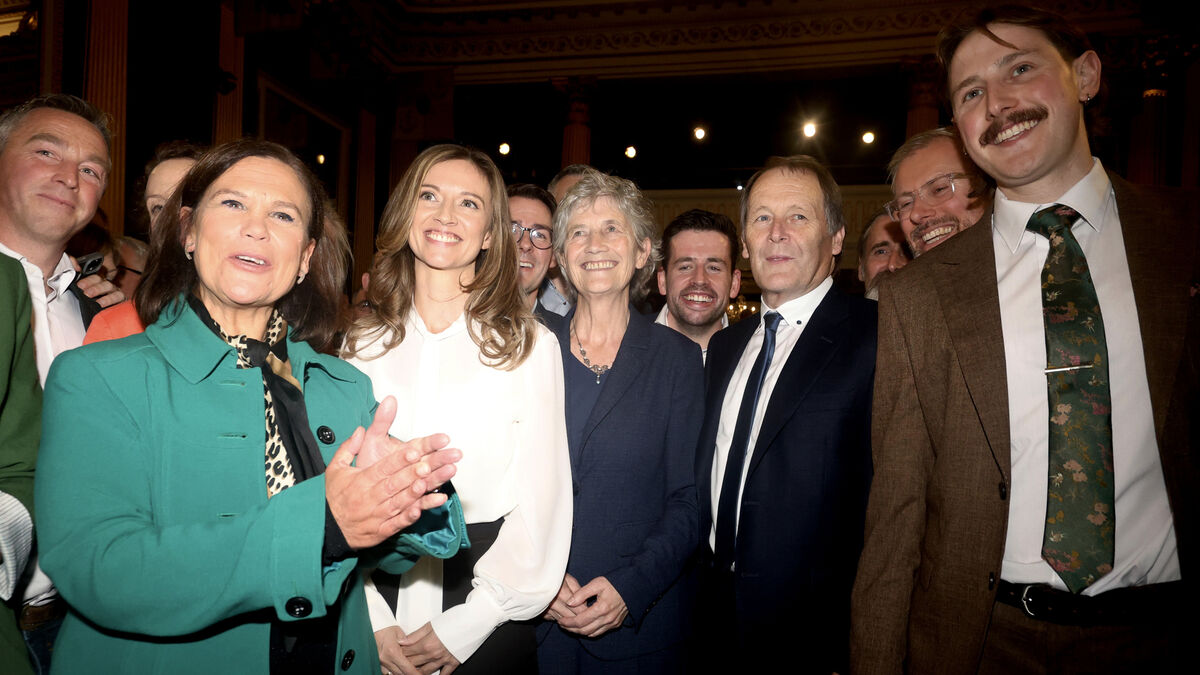
Independent winning presidential candidate supported by a united left alliance Catherine Connolly with Sinn Fein and Social Democrats leaders Mary Lou McDonald and Hollie Cairns while arriiving in Dublin Castle. Pic: Leah Farrell/© RollingNews.ie
The election is over, and with it, a moment of real change has arrived. For the first time, we’ve witnessed a united left take on the two dominant political parties of the nation — and win. It’s the first time the left has come together, stayed together, and successfully backed a single candidate to victory.
Like many, I wasn’t overly impressed by the choices on offer. But as I said last week, at least we had a choice — and, by and large, we made one. I went out and voted; others chose to stay at home. In total, more than 1.6 million people cast their ballots, and of that number, 213,738 were recorded as spoiled.
As with all matches played or elections fought, there must now be an analysis of what happened — especially for those on the losing side. There’s been plenty of talk about Micheál Martin’s position after the Jim Gavin debacle. I can’t see him going until after Ireland’s Presidency of the EU, but after that, a new leader seems likely.
There’s less talk about the other government party, but you can be sure there’ll be some serious head-scratching within Fine Gael — not just over the loss itself, but over its scale. Why was Heather Humphreys’ vote so low in some areas that the number of spoiled ballots actually exceeded her tally? It’s not a great look for Fine Gael, and certainly not for their leader, Simon Harris. He’s arguably the weakest leader they’ve had when it comes to elections. Have they performed well in any contest with him at the helm — local, European, Dáil, or presidential? Yet, remarkably, there’s no sign of any rumblings within the party.
I’ve been watching elections since I was a pupil in Loughglynn National School. I was bitten by the political bug at a young age and was blessed to witness the great battles of the 1980s — nationally between Haughey and FitzGerald, and locally between Doherty, Leyden, Conor, Naughten, and Foxe here in Roscommon.
Later came the fascinating European contests — the arrival of Dana, Marian Harkin, and Ming Flanagan, and the way each fared against the main parties. Then there were the presidential elections: Mary Robinson’s groundbreaking victory over Currie and Lenihan; and who could forget Padraig Flynn putting his welly in his mouth on RTÉ Radio 1 when he attacked Robinson as a parent? He’s often credited with sinking Lenihan’s campaign — though there were other factors — and Robinson ultimately came out on top after the second count.
Then came Mary McAleese, who won her first election by defeating Mary Banotti, Dana Rosemary Scallon, and Derek Nally — the latter two both nominated by county councils in 1997. When 2004 came around, McAleese faced no opponent at all. The nation, it seemed, was happy with her performance.
Then we entered the Higgins era. In 2011, Michael D. Higgins faced off against six candidates: Mary Davis, Seán Gallagher, Martin McGuinness, Gay Mitchell, David Norris, and Dana Rosemary Scallon. That campaign is best remembered for the dramatic Frontline debate on RTÉ with Pat Kenny, when an allegation surfaced about Gallagher collecting an envelope with a cheque for Fianna Fáil. A false tweet read out on air caused major damage — widely seen as derailing Gallagher’s campaign and clearing the way for Higgins’ victory.
In 2018, President Higgins ran again, facing Liadh Ní Riada of Sinn Féin, and Peter Casey, Gavin Duffy, Joan Freeman, and Seán Gallagher. Peter Casey, who had not featured strongly in early polls, made a late surge after making controversial comments about the Traveller community — a move many saw as the reason for his sudden rise and second-place finish.
And now, after all those years of contests, this election felt different. What did happen? We saw Gavin pull out, and Catherine Connolly kick a football with some children — even managing a few “keepie uppies” — and she won the internet. The campaign itself was a slow burner, with little real excitement. But Connolly was there from early summer, and steadily her movement grew. She took control, arranged the battlefield, dominated the agenda, and ultimately won the war. Now she is set to become our tenth President of Ireland.
Connolly’s victory marks more than just a change in personnel at Áras an Uachtaráin — it signals a deeper shift in Irish politics. For decades, power has oscillated between the traditional giants, with the presidency generally favouring Fianna Fáil except for Higgins and Robinson. This time, the people took ownership of that decision. A grassroots, issue-focused campaign with a vision, run without the machinery of the big parties, triumphed over the old order.
It’s a reminder that voters are paying attention — and that authenticity still counts. Connolly’s calm persistence, her independence, and her refusal to play by the old rules struck a chord with people tired of spin and safe choices. The left, for once, stayed united and disciplined, and it paid off.
For Fine Gael and Fianna Fáil, this result should be a wake-up call. The landscape is shifting. Voters no longer see politics as a family inheritance or a party loyalty test. They see it as a means to deliver real change — and they’ve just proven that when the message is clear and the candidate genuine, they’re more than willing to rewrite the rules.
For the first time in a long time, it feels like the people, not the parties, have the upper hand. Catherine Connolly’s election doesn’t just mark a new chapter in Irish politics. It may well mark the beginning of a new book entirely.