Herald Opinion: Are we ready to keep spending as if money is going out of fashion?
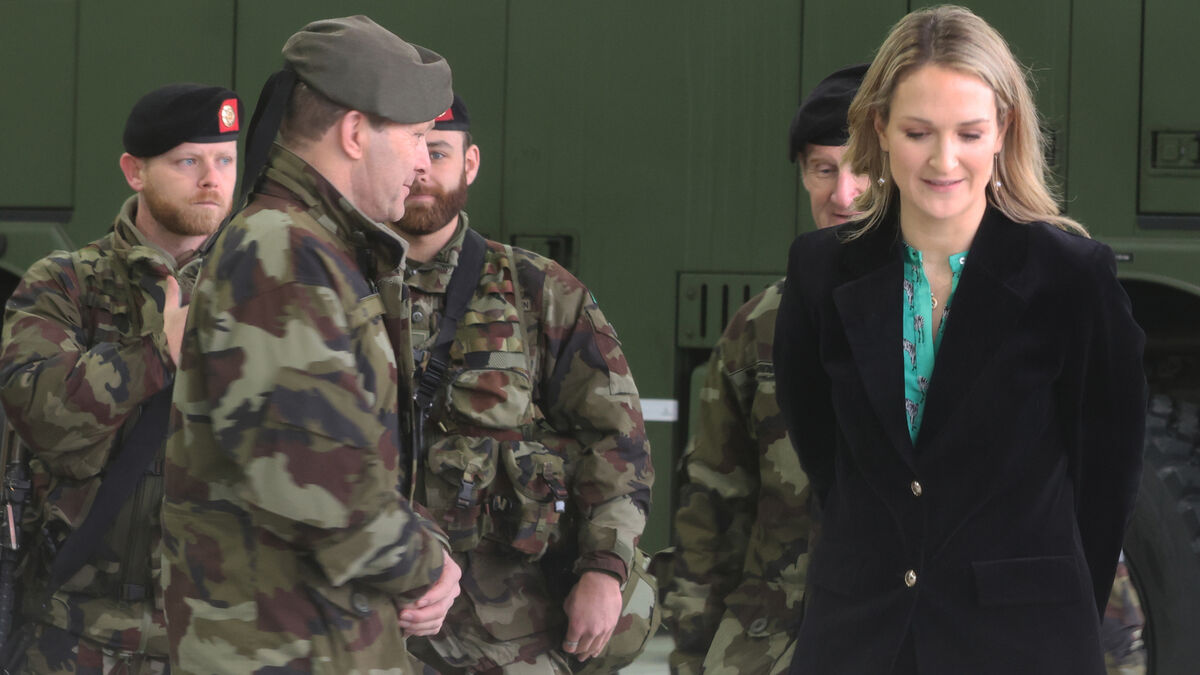
Minister for Defence and Foreign Affairs Helen McEntee, TD launched the National Development Plan at the Irish Defence Forces Curragh Camp. Pic:Eamonn Farrell/© RollingNews.ie
Last week on the news I saw the new Minister for Defence, Helen McEntee, jumping out of an army armoured personnel carrier, a MOWAG Piranha, to give it its proper name. Ministers love equipment, and what better prop to be filmed with than army hardware. Thankfully, she avoided the fate of “Corporal” Willie O’Dea, the former Minister for Defence, who was famously photographed pointing a pistol at a photographer — an image that has long outlived most of the policies of the time.
Minister McEntee was in the Curragh to re-announce what the Government describes as an unprecedented investment in the Irish Defence Forces, intended to make up for decades of underfunding. Few would argue that defence does not need attention. Ireland has allowed its capabilities to run down to the point where we are now heavily reliant on others to mind our patch. We may be a neutral country, but neutrality should not mean helpless. At present, we are dependent on our neighbours in the UK — the very crowd we pretend not to like — to protect our airspace, as we lack even a basic ability to intercept an unfriendly aircraft.
The implication, however, seems to be that with enough money, all our problems will simply be fixed. We will police our airspace, patrol our seas, counter cyber threats and rebuild capacity across the board. It all sounds very reassuring. I am not reassured!
In truth, we are not upgrading our Defence Forces so much as recreating them from scratch. Take the air corps. If Ireland was to begin serious air policing, it would require fighter jets. A single modern fighter aircraft costs in the region of €60 million. A credible squadron would typically consist of around twelve aircraft, bringing the headline cost alone close to €720 million. That is before pilots, engineers, ground crews, hangars, simulators, training pipelines, fuel, maintenance contracts and decades of ongoing support are factored in. You would be looking at close to a billion euro very quickly — and that would be for just one capability, probably based at Shannon.
The navy tells a similar story. At present, we can only just about put two ships to sea at any given time. During the recent visit of Ukrainian President Volodymyr Zelenskyy, a number of drones were reported off Dublin. Suggestions were made that this was Russia flexing its muscles. Perhaps it was, perhaps it wasn’t — but the uncomfortable reality remains that we were unable to respond in any meaningful way. We couldn’t even shoot one down! It is hard to project seriousness when you cannot even investigate, let alone deter, activity on your own doorstep.
And defence is only one part of the picture. The same spending pressures exist everywhere you look. In health it’s pretty obvious that we need another hospital in addition to what we already have. We know that the National Children’s Hospital has reached a cost of around €2.24 billion, with years of delays still behind it, how much would another adult hospital cost? Our population continues to grow, yet our hospital system is creaking at the seams. We clearly need more capacity, but building a new greenfield hospital is only part of the challenge. Could we staff it? Could we run it? Capital spending grabs headlines, but recurrent costs quietly pile up year after year.
Education follows the same pattern. Until recently, children seeking access to special education classes or schools required an Assessment of Need carried out by trained professionals. We now have more than 18,000 children waiting for such assessments. Instead of fixing delivery failures, the Government has opted to scrap the requirement altogether, shifting responsibility onto among others, teachers. Again, rather than building capacity, we lower the bar and pretend the problem has been solved.
Housing, water and sewerage infrastructure, transport, and immigration all demand substantial investment as well. Every one of these areas is presented as urgent, essential and unavoidable. And perhaps they are. But taken together, they represent an enormous and growing call on the public purse. And there are many more needs looking for money too.
This brings us to the uncomfortable question: where is the money coming from? Workers saw little benefit in the most recent budget, and we already know that roughly a third of taxpayer units — more than a million earners — pay no income tax or Universal Social Charge. That leaves a narrowing base carrying an expanding load. Corporation tax, meanwhile, remains volatile and exposed to international change. It is a risky foundation on which to build long-term commitments.
Are we ready to keep spending as if money is going out of fashion? Are we prepared to have an honest conversation about priorities, trade-offs and limits? Because at some point, the sums stop adding up. Pretending otherwise may be comforting, but it is not a strategy.